Grind medium-fine, fill the chamber loosely, start around 180°C and step up in 10° increments. Draw slowly for four to six seconds rather than hard and fast. Almost every harsh first session is a grind or a temperature problem, not a fault in the device you just bought.
What the temperature does for you
A dry herb vaporizer heats ground cannabis until its compounds come off as vapour, and stops short of the point where the plant burns. That gap is the whole product. Set it too low and very little leaves the chamber; set it too high and you are approaching combustion, which is the thing you bought the device to avoid.
The useful working range is roughly 180°C to 210°C. Below about 175°C most people get a thin, almost invisible vapour and assume the device is broken. It is not: there is simply not enough energy going into the chamber yet.
Where to start, and why
Start at 180°C and go up in 10° steps between draws. This is not folklore. The most careful published test of vaporizer output set every electrically driven device it examined to a single temperature — 210°C — and measured what came out by gas chromatography. That figure is a sensible ceiling for a first session and a good place to finish a bowl rather than begin one.
210°CThe single temperature every electric vaporizer was set to in the PLoS One validation study.
82.7%The best total-THC recovery in the vapour of any electric device tested. The worst managed 54.6%.
4–6 secA draw long enough to pull heated air through the load without cooling the chamber.
How much you actually get
Here is the number almost no buying guide prints. When four mains and battery powered vaporizers were run at the same 210°C with the same material, the share of the total THC and total CBD in the plant that actually reached the vapour varied by nearly thirty percentage points between devices.
Total THC and CBD recovered in the vapour at 210°C, by device | ||
Vaporizer | Total THC in vapour | Total CBD in vapour |
|---|---|---|
Arizer Solo | 82.7% | 70.0% |
Plenty | 66.8% | 56.1% |
Volcano Medic | 58.4% | 51.4% |
DaVinci | 54.6% | 56.7% |
Two things follow. The first is that a device is not a device: the same flower, the same heat and the same operator produced very different output depending on what it went through. The second is that none of them got everything. Even the best left roughly a fifth of the available THC behind, which is why spent material still looks and smells like something rather than ash.
How fine to grind
Medium-fine, and even. Hot air has to pass through the load, and the load is a filter. Grind it coarse and the air runs around the pieces instead of through them, so the outside of each nugget gives up its compounds and the inside never gets warm. Grind it to powder and you get the opposite problem: the air cannot get through at all, the draw goes tight, and fines end up in the mouthpiece.
A two-piece grinder taken to about ten twists is the right texture for almost every portable device. If your vaporizer came with a screen, that screen is the reason powder is a problem.
How to pack the chamber
Full, level and loose. An underfilled chamber lets air bypass the material through the empty space above it, which reads as a weak session and sends people straight to a higher temperature they did not need. An overpacked one restricts the draw and scorches whatever is touching the wall.
The test is the draw itself: it should feel like drinking through a wide straw. If it feels like a thin one, take some out.
How to draw
Slowly, for four to six seconds. A vaporizer is not a pipe and rewards none of the same habits. A hard, fast pull drags cool room air through the chamber faster than the element can reheat it, so the temperature at the material drops exactly when you want it steady, and the vapour thins out.
Long and gentle keeps the chamber at temperature. If your device has a visible light or a haptic cue, use it: most are telling you the element is keeping up.
What a session looks like
Expect a session rather than a hit. A full chamber usually gives eight to twelve draws across five to fifteen minutes, and the character changes as it goes: the first draws carry most of the aroma, the middle ones are the fullest, and the last are thin and taste toasted. That progression is the point at which to stop, not a fault.
Conduction or convection
Conduction heats the chamber wall and the material touching it. Convection pushes hot air through the load instead. Conduction devices are cheaper, warm up faster and need a more careful pack, because whatever touches the wall gets the most heat. Convection devices are more even and more forgiving of a loose grind, and cost more for it.
Most portables are a hybrid, which is why the packing advice above matters more than the label on the box.
What the screen is for
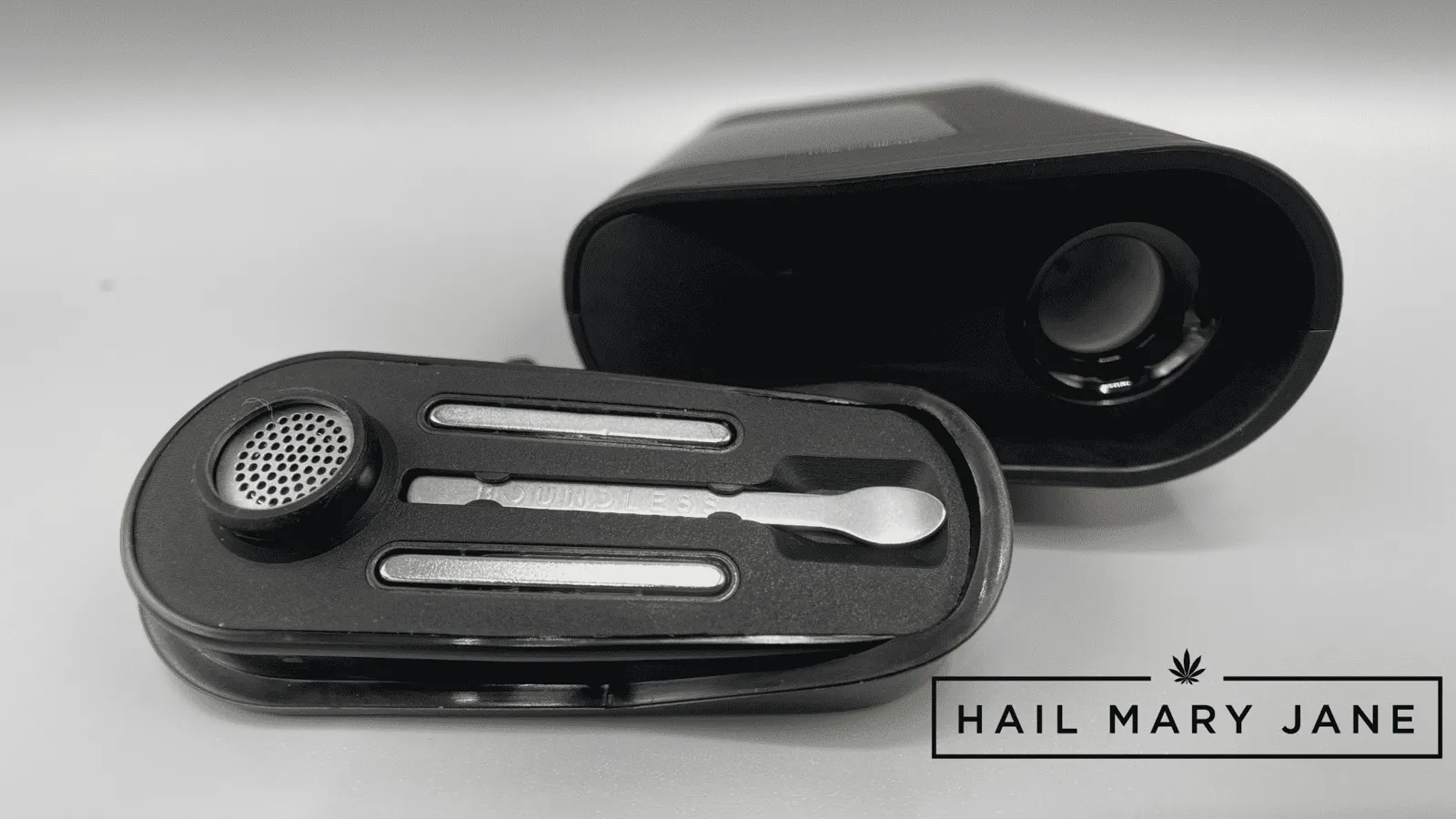
The little mesh disc between the chamber and the mouthpiece is not a filter in any useful sense. Its job is to keep plant matter out of the vapour path and out of your mouth, and it is the first part of the device to clog. A screen that has gone dark and stiff is the usual reason a draw has tightened, and it is a two-minute fix rather than a fault.
Most devices ship with a spare because the manufacturer expects you to lose or ruin the first one. Keep it somewhere you will find it.
Heat-up time and battery
A portable takes somewhere between twenty seconds and a minute to reach temperature, and the number matters more than it sounds: a device that heats slowly gets used less. Battery life is better read in sessions than in minutes, because the element draws most of its power holding temperature through a draw rather than sitting idle between them.
Running a battery flat repeatedly is the fastest way to shorten its life, and on most portables the battery is the part that fails first while everything else still works.
When to stop and reload
Stop when the vapour thins and the taste turns toward toast. What is left in the chamber is not spent in the sense of being worthless — the recovery figures above say a meaningful share of the cannabinoids never left it — but it is spent in the sense that pushing the temperature higher to chase the rest is how a session turns harsh.
Cleaning, and how often
Every five to ten sessions for a portable, and immediately if the draw has gone tight. Residue collects in the mouthpiece, the screen and the vapour path, and it narrows the airway before it does anything else. A tight draw that appeared gradually is almost always dirt rather than a fault.
Isopropyl alcohol and a cotton bud handle the mouthpiece and screen. Keep liquid away from the element and the electronics, and let everything dry completely before the next session.
What goes wrong first
In order of how often we see it: the grind is too coarse, the chamber is half full, the draw is too hard, and the temperature has been pushed up to compensate for the first three. Fix them in that order before deciding the device is the problem.
If you are choosing rather than troubleshooting, our vaporizer buying guide covers what separates the price brackets, and the reviews are the devices we have actually run.

Questions people ask
What temperature should a dry herb vaporizer be set to?
Start around 180°C and step up in 10° increments as the session goes on. The published validation of vaporizer output set every electrically driven device to 210°C, which makes that a reasonable upper bound rather than a starting point. Below roughly 175°C the vapour is thin enough that most people assume the device is faulty.
Why is my vaporizer not producing visible vapour?
Usually temperature, then pack. Vapour is much less visible than smoke at any setting, and at the bottom of the range it can be almost invisible while still carrying plenty. If the chamber is only half full, air bypasses the material through the empty space above it, which produces the same complaint. Fill it level and loose before raising the heat.
How fine should I grind for a vaporizer?
Medium-fine and even. Hot air has to pass through the load rather than around it, so coarse pieces heat on the outside only. Powder causes the opposite problem, restricting the draw and clogging the screen. About ten twists in a two-piece grinder suits almost every portable.
Is the material still usable after vaping?
Something is left in it. At a fixed 210°C the best device tested moved 82.7% of the available THC into the vapour and the worst 54.6%, so a meaningful share stays in the chamber. That is a fact about recovery rates, not a recommendation about what to do with the remainder.
How often should a dry herb vaporizer be cleaned?
Every five to ten sessions, and straight away if the draw has become tight. Residue narrows the airway before it affects anything else, so a draw that has gradually stiffened is nearly always dirt rather than a fault. Isopropyl alcohol and a cotton bud on the mouthpiece and screen, kept away from the element, and dry before reuse.
Sources
- Lanz C, Mattsson J, Soydaner U, Brenneisen R. Medicinal Cannabis: In Vitro Validation of Vaporizers for the Smoke-Free Inhalation of Cannabis. PLoS One 2016;11(1):e0147286. The 210 C setting and the vapour recovery figures for each device. .gov accessed Sep 18, 2026
- Pomahacova B, Van der Kooy F, Verpoorte R. Cannabis smoke condensate III: the cannabinoid content of vaporised Cannabis sativa. Inhalation Toxicology 2009;21(13):1108-12. .gov accessed Sep 18, 2026