
What an electric grinder is
A motor, a battery, a set of teeth or blades, and a chamber. Press a button instead of turning a lid. That is the whole idea, and the distance between the good ones and the pointless ones is entirely in what happens to the material after it has been ground.
The motion it replaces
A manual grinder asks for a pinch grip on the lid, a pinch grip on the body, and rotation of the forearm against whatever resistance the flower puts up. It is a small ask for most people and a real one for some, and it is repeated every single time.
What the strength data shows
Mathiowetz and colleagues measured grip and pinch strength across 310 men and 328 women aged 20 to 94, split into twelve age bands, in the study clinicians still use as the reference. Grip peaked between 25 and 39. Tip, key and palmar pinch held roughly steady from 20 to 59 and then declined steadily from 60 to 79. Pinch is precisely the grip a grinder lid asks for.
That is a statement about hands and levers, not about anyone’s health. If turning a grinder is uncomfortable, an electric one is a tool that removes the motion; it is not a treatment for anything, and nothing on this page should be read that way.
Two different devices, one name
Half of what is sold as an electric grinder does grind. The other half grinds very little and exists to dispense — to push an even, measured amount of already-ground flower into a cone or a bowl without you tipping a chamber over and losing half of it. Both are useful. They are not substitutes, and the listings rarely make the difference plain.
What is in this category
Four devices are worth naming, and they line up as two grinders, one hybrid and one dispenser. The numbers below are the manufacturers’ own specifications; where we have used a device ourselves the notes say so.
| Device | Mechanism | Capacity | Stated runtime | Dispenses |
|---|---|---|---|---|
| Cloudious9 Tectonic9 | 28 CNC-cut teeth, vibrating spout | Grinder-sized chamber | Not published | Yes, via flip spout |
| Banana Bros OTTO | Spring-loaded jaw, chunky teeth | One cone at a time | 20 to 30 cones per charge | Into cones only |
| Mamba | Motorised, forward and reverse | Small, portable | About 3 hours continuous | No |
| Pen Simple | Manual grind, motorised feed | 1.2 g, or 3 g without the grinder | About 75 fills claimed | Yes, one-handed |
Carried across from the earlier version of this page so the formats can be compared side by side. These are not recommendations: we have not tested them, and the details on each need checking against current listings before anyone acts on them.
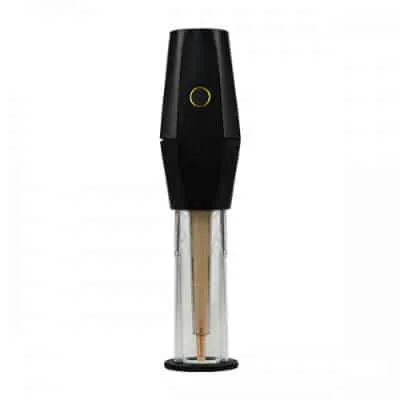
BANANA BROS OTTO
Banana Bros OTTO Automatic Grinder
Premium
- Automatic Smart Rolling Machine
- Otto Grinder Review
- OTTO grinder
- Measuring Cup
- USB Rapid Charging
- Cable
The Banana Bros OTTO electric grinder is a bit more pricey than some of the other competitorS. It’s primarily advertised as an automatic rolling machine, however, does less rolling and more packing cone blunts. Although packing cones is its primary purpose, it can be used for filling other contraptions as well.
The design is simple and intuitive with the unit hinged at the grinding chamber with a tab latch, instead of being magnetic or screw-on. Depending on the difficulty of use with the tab latch, it should be easier on arthritic hands than a screw-on.
The grinding chamber is designed similar to a traditional herb grinder with big chunky teeth. One of the jaws is spring-loaded to imitate a traditional manual grinder by adding pressure to the teeth to enhance the grinding action.
Once loaded, the unit is actuated with the press of a button. The battery life claim is that it can fill 20-30 cones before needing to be recharged, which you can do with the included micro USB cable.
The cone loading tube is magnetic and odor-proof, so you can load those cones to perfection without raising any suspicions. Also included is a magnetic O-funnel to fill other devices as well.
If you wan to find out more we recommend you to read our Otto Grinder Review.
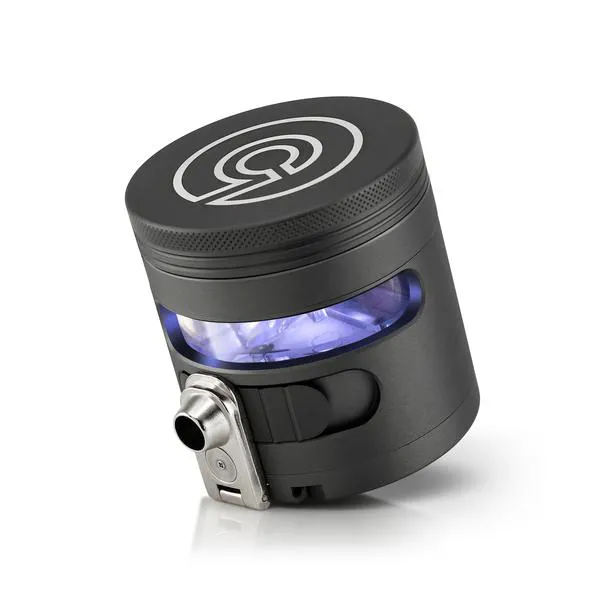
Tectonic9
Cloudious9 Tectonic9
Mid-range
- Tectonic9 Auto Dispensing Grinder
- Charging Cable
- Charging Bag
- User Manual
The Tectonic9 is a unique contender in the electric grinder market. It closely resembles a simple manual grinder you can grab in any head shop, but it’s underneath the hood is carefully thought out technology that ensures you never waste any precious herb (or keif for that matter). 28 CNC manufactured teeth grind your flower to a fine and fluffy consistency, and the lighted viewing window lets you check your progress without exposing your dry herb to the outside.
After you’ve finished grinding your herb, there’s a built-in vibrational motor to move your material through the flip spout with accuracy to help the loading process. They’ve even incorporated a patent-pending internal structure to make sure your cannabis gets evenly distributed prior to dispensing so you can avoid getting clogs or jams in your device.

Mamba
Mamba Electric Grinder
Mid-range
- Available In 3 Colors
The Mamba Electric Grinder is one of our favorites for its low price point and portable design. Despite its small size, the Mamba has a powerful internal motor that will grind for a continuous 3 hours on a full charge. The Mamba utilized a patented rocker-switch that allows for forward and reverse grinding capabilities so you can you avoid clogging and stalling your device.
PEN SIMPLE
Electric Weed Grinder Pen Simple
Premium
- Up To 1.2 Grams Of Storage
- Pen Simple modular grinder/dispenser
- Loading funnel
- Micro USB charging cable
- Point plug
The Pen Simple is less of an electric grinder and more of an electric dispenser. You have to manually grind the herb (which isn’t great if you have mobility issues in your hands) and you can store up to 1.2 grams (or 3 grams without the grinder). So you can grind what you need ahead of time and store almost an eighter to take with you on your adventures. The Pen Simple allows for one-hand dispensing with the push of a button, which is rather handy when filling a bowl, pipe, doob, or vape. This means more herb where you want it, and less on the ground or in your lap.
Pen Simple’s modular design allows for you to adjust the device to suit nearly any type of need. You can utilize the Pen Simple in three ways: direct grind, grind/store/dispense, or store/dispense. Each piece is made of anodized aluminum that screws together to make a whole unit totaling about 7 inches (~175mm) in length and 1-inch diameter (~25mm), so less of a pen and more of magnum marker. The unit is water resistant and non-odor-permeable when the point plug is inserted, so you can enjoy your outdoor activities without worrying about ruining your herb or your experience. With a claim that you can dispense into 75 devices, and with the included micro USB charging cable, you don’t have to worry about replacing the battery.
There have been some minor complaints that the grinder doesn’t get as fine a grind as some might want, however overall it seems everyone that has this product is pleasantly surprised with its usability.
Tooth count and chamber size
The Tectonic9 is the only one of the four that publishes a tooth count, and 28 CNC-cut teeth in a hand-sized chamber is a genuine number rather than a slogan. The OTTO takes the opposite approach: fewer, much larger teeth with one jaw spring-loaded so it presses into the material the way your hand does. Both work. The OTTO is doing a cone at a time; the Tectonic9 is doing a grinder’s worth.
Runtime is the honest number
Ignore battery capacity in milliamp-hours, which tells you nothing across four different motors. Runtime does tell you something, but only if you read what it is counting. Three hours continuous, as Mamba claims, is a motor-on figure and you will never run it for three hours. Twenty to thirty cones, as the OTTO claims, is a unit of work, and that is the number worth comparing.
Charging, cables and standards
Most of this category still ships micro-USB, which in a drawer full of USB-C is an irritation rather than a fault. Check before you buy, because a cable you have to keep track of is the reason a device stops getting used.
Almost none of them catch kief
This is the trade, and it is buried in every listing. Cannabis resin heads measure 40 to 110 micrometres across, and separating them needs the ground material to sit still on a screen while gravity and a little agitation do the work. An electric grinder is built to move material straight out of the chamber — that is the point of it — so there is nowhere for that to happen.
Why that is a real trade-off
If you never use the kief chamber on your manual grinder, you are giving up nothing and should buy whichever electric device suits your hands. If you empty it regularly, understand that going electric means the resin stays on the flower rather than accumulating separately. That is not a loss of material. It is the loss of the ability to save it up.
Clogging, and the reverse switch
Motorised teeth stall on a stem or a piece that is too damp, and a motor that can only turn one way then sits there straining. The Mamba’s rocker switch runs the motor backwards to clear it, which sounds like a gimmick until the first time you need it. On devices without one, the fix is to open it and pick the obstruction out.
Cleaning one without killing it
Resin on teeth is the same problem it is on a manual grinder and the same solvent answers it: isopropyl alcohol, a stiff brush and patience. The difference is that half the device is now a motor and a battery.
Never submerge the motor half
If the grinding chamber detaches, soak that and only that. If it does not, swab it. Nothing that contains a cell goes in liquid, ever, and a lithium cell that has been soaked and dried is not a cell you want in a pocket. Where a chamber is plastic rather than metal, hot water is the safer solvent, because isopropyl will haze and eventually craze some plastics.
The shells and their coatings
The same material rules apply as to a manual grinder. Anodised aluminium under MIL-A-8625F is what you want on anything that touches flower; raw aluminium sheds. A slick internal coating is a perfluorocarbon resin, regulated for food contact in the US under 21 CFR 177.1550 with extraction limits of 3.1 milligrams per square decimetre total and 0.46 for fluoride. Ask which grade it is; the answer tells you what kind of manufacturer you are dealing with.
Building your own is not worth it
The legacy version of this page walked through making one from a hobby motor, a battery and some sheet metal. It is possible. It also produces an uncoated, unsealed, unearthed device with sharp steel spinning inside it, for less than the price of the cheapest thing in the table above. We have taken the instructions down and we are not putting them back.
Who should buy one
- Anyone who finds the twist of a manual lid uncomfortable or awkward.
- Anyone filling cones in quantity, where the OTTO-style devices do a job a manual grinder simply cannot.
- Anyone who has already decided they do not care about kief.
Who should not
- Anyone who empties a kief chamber and would miss it.
- Anyone who wants one device for years — a machined manual grinder has no battery to degrade and no motor to stall.
- Anyone buying on the promise of a finer grind, which is not what these are for.
Where the links went
This page used to carry discount codes and buy buttons for a programme that no longer exists, and every one of those links is dead. They are gone rather than patched. The specifications stay, because they are what the page is for; when there is a working destination worth sending anyone to, it will appear here with the commercial relationship disclosed. For what is in stock near you, that is BudFinders rather than this site.

Questions people ask
Do electric weed grinders have a kief catcher?
Almost none of them do. Separating resin needs ground material to rest on a screen while gravity and gentle agitation work the 40 to 110 micrometre trichome heads through it. An electric grinder is designed to move material straight out of the chamber, so there is nowhere for that to happen. If you use your kief chamber, this is the thing you are giving up.
Are electric grinders better than manual ones?
They are faster and they need no wrist, and they usually grind less finely and collect no kief. A machined manual grinder also has no battery to degrade and no motor to stall. Buy electric for the motion or for filling cones in quantity, not on the expectation of a better grind.
How do I clean an electric weed grinder?
Take the grinding chamber off if it detaches and soak that alone in isopropyl alcohol, then brush and rinse it. Swab it in place if it does not. Never put the half that holds the motor and the battery into any liquid. If the chamber is plastic rather than metal, use hot water instead, because isopropyl hazes some plastics.
Why has my electric grinder stopped turning?
Usually a stem or a piece of damp flower has jammed the teeth. Devices with a reverse switch, such as the Mamba, run the motor backwards to clear it. On the rest, open the chamber and pick the obstruction out rather than holding the button down, which is how a small motor gets cooked.
Sources
- Mathiowetz V, Kashman N, Volland G, Weber K, Dowe M, Rogers S. Grip and pinch strength: normative data for adults. Arch Phys Med Rehabil. 1985;66(2):69-74. accessed Sep 18, 2026
- Punja ZK, Sutton DB, Kim T. Glandular trichome development, morphology, and maturation are influenced by plant age and genotype in high THC-containing cannabis (Cannabis sativa L.) inflorescences. J Cannabis Res. 2023;5:12. accessed Sep 18, 2026
- 21 CFR 177.1550 — Perfluorocarbon resins. US Food and Drug Administration, Code of Federal Regulations. .gov accessed Sep 18, 2026
- MIL-A-8625F, Military Specification: Anodic Coatings for Aluminum and Aluminum Alloys. US Department of Defense, 10 September 1993. accessed Sep 18, 2026