PAX 3
Pros
- Ten-year warranty, in a category where two is generous
- Heats in about twenty seconds, three times quicker than the PAX 2
- 90 to 110 minutes of heating from a 3500 mAh cell
- Half-pack lid makes a small load work in a conduction oven
- Anodised aluminium body that survives years of pockets
Cons
- Conduction, so the flavour is good rather than excellent
- Oven stops at 215 C, which the concentrate insert needs it not to
- Battery is sealed and not covered by the warranty
- Custom temperature and the four modes need the phone app
- Awkward screen design, and performance drops quickly when dirty
What the PAX 3 is
A pocket-sized dry herb vaporizer in an anodised aluminium shell with no buttons on the outside, a magnetic oven lid underneath and a mouthpiece you press to switch it on. It is lip-sensing, so there is nothing to hold down while you draw, and it buzzes when it has reached temperature.
Conduction, and what it costs
The oven is a metal chamber that heats the flower by contact. That is why it warms up in seconds and why it is nearly impossible to break, and it is also why the flavour is good rather than excellent. Convection devices taste better. None of them will take the treatment this one will.
How fast it actually heats
PAX quote about fifteen seconds and our own timing put it nearer twenty from cold, which is still three times quicker than the PAX 2 and quick enough that the wait stopped registering. The haptic buzz when it is ready is a small thing that turns out to matter, because the alternative is watching a light.
The temperature range in context
The PAX 3 runs from 360 to 419 °F, which is 182 to 215 °C. That upper figure is worth holding on to: the controlled work on vaporizer efficiency was run at 210 °C, so this device at its hottest is sitting essentially at the laboratory benchmark. In that study, four electric vaporizers at that same temperature recovered between 54.6 and 82.7 per cent of their total THC. The dial is not what separates devices.
Five settings, four of them fixed
Four presets are stepped across that range and the fifth is a custom setting, which you can only reach through the phone app. Without the app you have four temperatures, and for most people four is enough.
The app, and what it unlocks
Bluetooth, and a reasonable argument that half of what you paid for lives behind it. Without it the PAX 3 is a faster PAX 2 with a bigger battery. With it you get the custom temperature, the four modes below, a battery readout in numbers rather than lights, and the ability to name the device, which nobody needs.
Boost, Stealth, Efficiency, Flavor
- Boost
- Reduces the auto-cooling between draws. The oven runs hot, and the device gets noticeably warm in the hand if you leave it there.
- Stealth
- Dims the lights and cools faster. Effectively the battery-saving mode.
- Efficiency
- Steps the temperature up gradually through a session, which is the closest this device gets to the way a convection unit behaves.
- Flavor
- Heats harder at the start of each draw. Better than it sounds on a conduction oven, and the mode we left it in.
Battery, in real numbers
A 3500 mAh cell, around 90 to 110 minutes of heating per charge depending on the mode, and roughly 110 minutes to charge from empty on the magnetic dock. Shake the device and a row of LEDs shows what is left. Those are good figures for the size, and PAX increased the capacity over the PAX 2 without making the body any larger.
The battery is not replaceable
This is the real limit on a device sold with a ten-year warranty, and the warranty does not cover batteries. A sealed lithium cell is good for a few hundred cycles, so the PAX 3 that outlives its battery is a repair job rather than a swap.
The oven, and the half-pack lid
The full oven takes about 0.3 g. There is a half-pack lid in the box, added after PAX 2 owners asked for it, which drops a raised plate into the chamber so a smaller load still sits firmly against the walls. On a conduction oven that is not a convenience, it is the difference between a half-filled chamber working and not working.
Grind finely, pack firmly
Because contact is the mechanism. A coarse grind in this oven gives you scorched pieces beside pale ones, and a loosely packed oven gives you very little at all. Grind finer than you would for a joint and press it down.
The concentrate insert
The complete kit includes a small metal canister that drops into the oven for extracts. It is the one component we would tell you to ignore, and it is not a matter of taste.
Why it leaves a mess
Infrared thermography of extract hardware found cartridge coils running between 246 and 543 °C depending on the system, with a temperature-controlled pod holding 420. The PAX 3 oven stops at 215 °C. It is not close, and it was never going to be: the insert warms an extract to roughly half the temperature the purpose-built hardware uses, so a good deal of it stays in the canister as residue you then have to soak out.
What is in the box
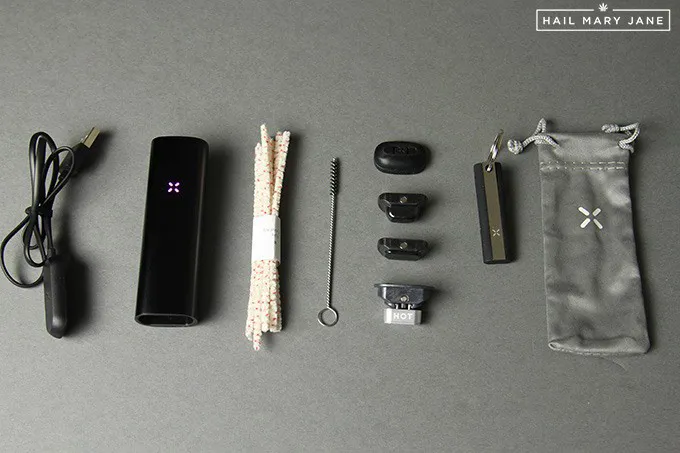
The complete kit carries the device, a magnetic charging dock and cable, two mouthpieces — one flat, one raised — two oven lids including the half-pack, three spare screens, a multi-tool, the concentrate insert with a spare o-ring, and a maintenance kit. The basic kit drops the spare screens, the multi-tool, the concentrate insert and the second oven lid. Given what we think of the insert, the basic kit is the better buy for most people.
Using it, day to day
Press the mouthpiece to wake it, hold the same button to open the temperature menu, short presses to step through the four settings, hold again to select. It heats, it buzzes, you draw. There is no screen and nothing to read, which after a week stops feeling like a limitation. Shaking the device shows the battery as a row of lights, which is the one interaction that never quite becomes second nature.
Build, finish and fingerprints
Anodised aluminium, no visible seams, no buttons. The original gloss finish showed every fingerprint, which PAX answered with a matte option, and the matte is the one to have. It survives pockets, drops and years in a way that almost nothing else in the category does.
Cleaning is not optional
The screen design makes the chamber awkward to get at, and performance falls off measurably once resin builds up. Flower left in the oven between sessions goes sticky within a day or two and makes it worse. The maintenance kit in the box does the job; the discipline is the hard part.
The ten-year warranty
Ten years against defects, which is extraordinary in a category where two is generous, and it is the strongest single argument for buying this device over a better-tasting one. Read the exclusions: batteries are not covered, and neither is neglect.
PAX 3 against the Firefly 2
| PAX 3 | Firefly 2 | |
|---|---|---|
| Heating | Conduction | Convection, on demand |
| Heat-up | About 20 seconds | Per draw, near instant |
| Flavour | Good | Better |
| Battery | 90 to 110 minutes, sealed | Shorter, two cells supplied |
| Durability | Exceptional | Ordinary |
| Warranty | Ten years | Two |
The Firefly tastes better and the PAX survives. Which of those you want is the whole decision.
Who it suits
- Anyone who wants one device and does not want to think about it again for years.
- Anyone who will actually use the app, where most of the PAX 3 over the PAX 2 lives.
- Anyone who values a pocketable, robust thing over the last ten per cent of flavour.
Who should look elsewhere
- Anyone buying primarily for taste, who wants convection.
- Anyone buying it for concentrates, which is what the insert implies and the oven temperature contradicts.
- Anyone who will not clean it, because this one punishes that more than most.
We have not been paid for this and there is no working link on it to pay us. Where to buy one and what it costs near you is BudFinders rather than this site. For how the category works in general, start with vaporizers.
Verdict
Buy it for the warranty and the build, not for the taste. The PAX 3 is the portable that is still working in five years, and the price of that is a conduction oven that a good convection device will beat on flavour every time. Ignore the concentrate insert: at 215 °C the oven reaches roughly half the temperature purpose-built extract hardware runs at, and the residue in the canister is the proof. If you will use the app, the upgrade over a PAX 2 is real; if you will not, it is a faster PAX 2 with a bigger battery.

Questions people ask
Is the PAX 3 conduction or convection?
Conduction. The oven heats the flower by direct contact with a hot metal wall rather than by passing hot air through it. That is why it warms up in about twenty seconds and why it is so hard to break, and it is also why a good convection device will beat it on flavour. Pack the oven firmly, because contact is the whole mechanism.
Can the PAX 3 be used with concentrates?
It ships with an insert for them and we would not bother. The oven stops at 215 °C, while thermography of purpose-built extract hardware measured coils running between 246 and 543 °C. The insert warms an extract to roughly half the temperature it is formulated for, and a good deal of it stays behind as residue.
How long does the PAX 3 battery last?
Around 90 to 110 minutes of heating from its 3500 mAh cell, depending on the mode, and about 110 minutes to recharge on the magnetic dock. The cell is sealed in and is specifically excluded from the ten-year warranty, so it sets the real lifespan of the device at a few hundred charge cycles.
Do I need the PAX app?
Only if you want the custom fifth temperature, the four session modes and a numeric battery readout. The four preset temperatures work with no phone anywhere near the device. Without the app, though, the PAX 3 is essentially a faster PAX 2 with a larger battery, which is worth knowing before you pay the difference.
Sources
- Lanz C, Mattsson J, Soydaner U, Brenneisen R. Medicinal Cannabis: In Vitro Validation of Vaporizers for the Smoke-Free Inhalation of Cannabis. PLoS One. 2016;11(1):e0147286. accessed Sep 18, 2026
- Oar MA, Savage CH, Rufer ES, Rucker RP, Guzman JA. Thermography of cannabis extract vaporization cartridge heating coils in temperature- and voltage-controlled systems during a simulated human puff. PLoS One. 2022;17(1):e0262265. accessed Sep 18, 2026
- Meehan-Atrash J, Luo W, Strongin RM. Toxicant Formation in Dabbing: The Terpene Story. ACS Omega. 2017;2(9):6112-6117. accessed Sep 18, 2026