
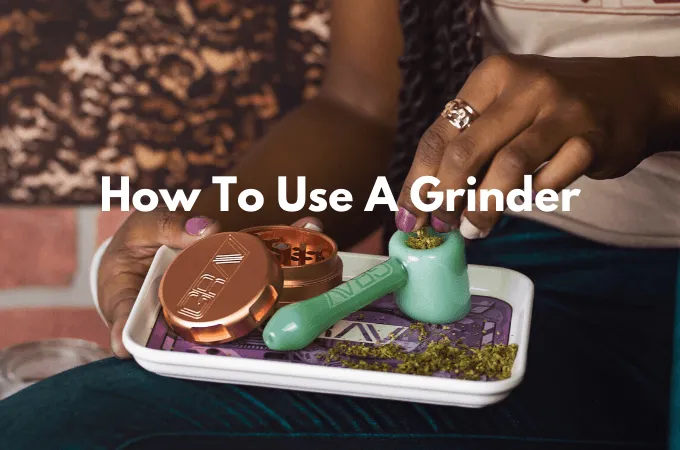
What you are actually doing
You are shearing flower between two sets of teeth until the pieces are small enough to fall between them. The grinder decides the maximum size of what comes out; you decide the minimum, by how long you keep turning. That second half is the part nobody explains.
First, is it dry enough
Properly cured flower breaks with a little snap and leaves a trace of stickiness on your fingers. Flower that squashes rather than breaking will pack itself into the teeth and smear, and no amount of turning improves it. Fifteen minutes out of the jar on a plate usually fixes it; five minutes in the freezer fixes it faster and makes the resin brittle enough to separate.
Break it down by hand first
A whole dense nugget will sit on the teeth and rotate with the lid instead of being cut. Pull it into three or four pieces first, roughly the size of a pea. This is the single change that turns a grinder people describe as weak into one that works in half the turns.
Load the ring, not the centre
Every grinder has a post or a magnet in the middle, and the teeth nearest it travel the shortest distance per turn. Material stacked over the centre gets pushed around rather than cut. Lay the pieces in the outer third of the chamber, spaced apart, where the teeth are moving fastest.
How much to put in
Enough to cover the floor of the chamber in a single layer, and no more. An overfilled grinder jams; a half-empty one grinds unevenly because the pieces move out of the way instead of being held against a tooth. Most four-piece grinders in the common 55 mm size take between one and two grams comfortably.
Ten turns, then stop
Close the lid, hold the body, and turn the lid. Ten full rotations is a reasonable default for a gram of properly dry flower in a sharp grinder. What you are listening and feeling for is resistance: while there is something to cut, you can feel it, and when the resistance goes, the job is finished and everything after that is the teeth polishing what has already fallen through.
Does the direction matter
Only at the start. Reversing direction once or twice at the beginning helps dislodge a piece that has wedged against a tooth, which is why the back-and-forth habit exists. Once material is moving freely, one direction is as good as the other.
What over-grinding costs you
A dust-fine grind packs into a joint like sand, restricts the draw and burns hot and fast down one side. In a bowl it pulls through the hole and into the stem. In both cases the fix people reach for is more airflow, when the cause was thirty extra turns.
Opening the chamber
Give the whole grinder a firm tap on the table before you open it, lid down. That knocks material off the teeth and out of the lid, so it ends up in the chamber rather than on the table when you separate the halves.
Getting it out without losing it
Tip the collection chamber over the thing you are filling rather than onto a tray and then into the thing you are filling; every transfer costs you material to static and to the rim. A folded card or the flat tool that came with the grinder scrapes the last of it out of the corner.
The screen and the kief chamber
If it is a four-piece, there is a mesh screen under the collection chamber and a smaller chamber below that. Resin heads work their way through as the grinder is handled — being carried in a bag does most of it. You do not need to shake it, and shaking it hard mostly pushes fine leaf through as well, which is why some kief is green.
How long the kief takes
Longer than people expect. Trichome heads are 40 to 110 micrometres across and there are not many of them by mass, so a well-used four-piece will produce a usable layer over weeks rather than days. If yours fills in three days, look at the colour: pale blonde is resin, green is leaf, and green means the screen is too coarse.
Grind size by what you are packing
- Joints and cones
- An even medium grind. Consistency matters more than fineness — one big piece is what makes a joint run, and dust is what makes it draw like a straw.
- Bowls and bongs
- Slightly coarser. The grind has to sit on the hole rather than pull through it, and airflow through the bowl is doing part of the work.
- Dry herb vaporizers
- Finer, and evenly so. A conduction oven heats by contact, so surface area against the chamber wall is the whole mechanism.
- Edibles and infusions
- Coarse. Fine material passes through a strainer and ends up as sediment in the butter.
When it gets hard to turn
Resin in the threads, nearly always, or a seed or a stem wedged between two teeth. Put the whole grinder in the freezer for twenty minutes and try again: cold resin is brittle and lets go. If it is still tight, it needs cleaning rather than more force, because forcing a galled aluminium thread is how the lid comes off crooked and never seats again.
Two-piece grinders need a habit
With nowhere for material to fall, a two-piece keeps cutting what it has already cut, so the ten-turn rule does not apply: four or five turns is usually the whole job. Open it and look rather than going by feel, because the resistance never really disappears — there is always something under the teeth. This is the one case where counting beats listening.
Do not store flower in the chamber
A grinder is not a jar. Ground flower left in the collection chamber dries out through the seams, loses its smell within a couple of days and starts sticking to the walls, and the resin that has already come loose sits on the screen going stale rather than falling through. Grind what you are about to use and keep the rest whole in something that seals.
Common mistakes, in order
- Loading a whole nugget instead of breaking it up.
- Stacking material over the centre post.
- Turning far past the point where the resistance stopped.
- Shaking the grinder to force kief through, which sends leaf through too.
- Leaving ground flower in the chamber for days, where it dries out and sticks.
If you do not have one to hand
Scissors and a glass will get you most of the way, and a few other kitchen objects will get you part of the way at a cost. We have measured what each one actually gives up in how to grind without a grinder. If you are choosing one to buy, the specifications worth reading are in our guide to grinders.

Questions people ask
How many times should I turn a grinder?
About ten full rotations for a gram of properly dry flower in a sharp grinder. The reliable signal is resistance rather than a count: while there is material left to cut you can feel it through the lid, and once that goes the grinding is finished. Everything after that point is making the grind finer than you want it.
Why is my grinder not grinding properly?
Three usual causes. The flower is too moist and is smearing instead of breaking, in which case leave it out for fifteen minutes or freeze it briefly. The nugget went in whole and is riding on the teeth, so break it into pea-sized pieces first. Or it is loaded over the centre post, where the teeth travel the shortest distance.
How do I get more kief in the bottom chamber?
Time and ordinary handling, mostly. Resin heads are only 40 to 110 micrometres across and there are not many of them by weight, so a usable layer takes weeks rather than days. Shaking it hard pushes fine leaf through the screen as well, which is why kief that arrives quickly is green rather than blonde.
How fine should I grind for a vaporizer?
Finer than for a joint, and evenly. A conduction oven heats the material by contact with the chamber wall, so surface area is the whole mechanism and an uneven grind gives you scorched pieces next to untouched ones. Do not take it to dust, which packs down and blocks the airflow the oven needs.
Sources
- Punja ZK, Sutton DB, Kim T. Glandular trichome development, morphology, and maturation are influenced by plant age and genotype in high THC-containing cannabis (Cannabis sativa L.) inflorescences. J Cannabis Res. 2023;5:12. accessed Sep 18, 2026
- MIL-A-8625F, Military Specification: Anodic Coatings for Aluminum and Aluminum Alloys. US Department of Defense, 10 September 1993. accessed Sep 18, 2026
- Livingston SJ, et al. Cannabis glandular trichomes alter morphology and metabolite content during flower maturation. Plant J. 2020;101(1):37-56. accessed Sep 18, 2026