
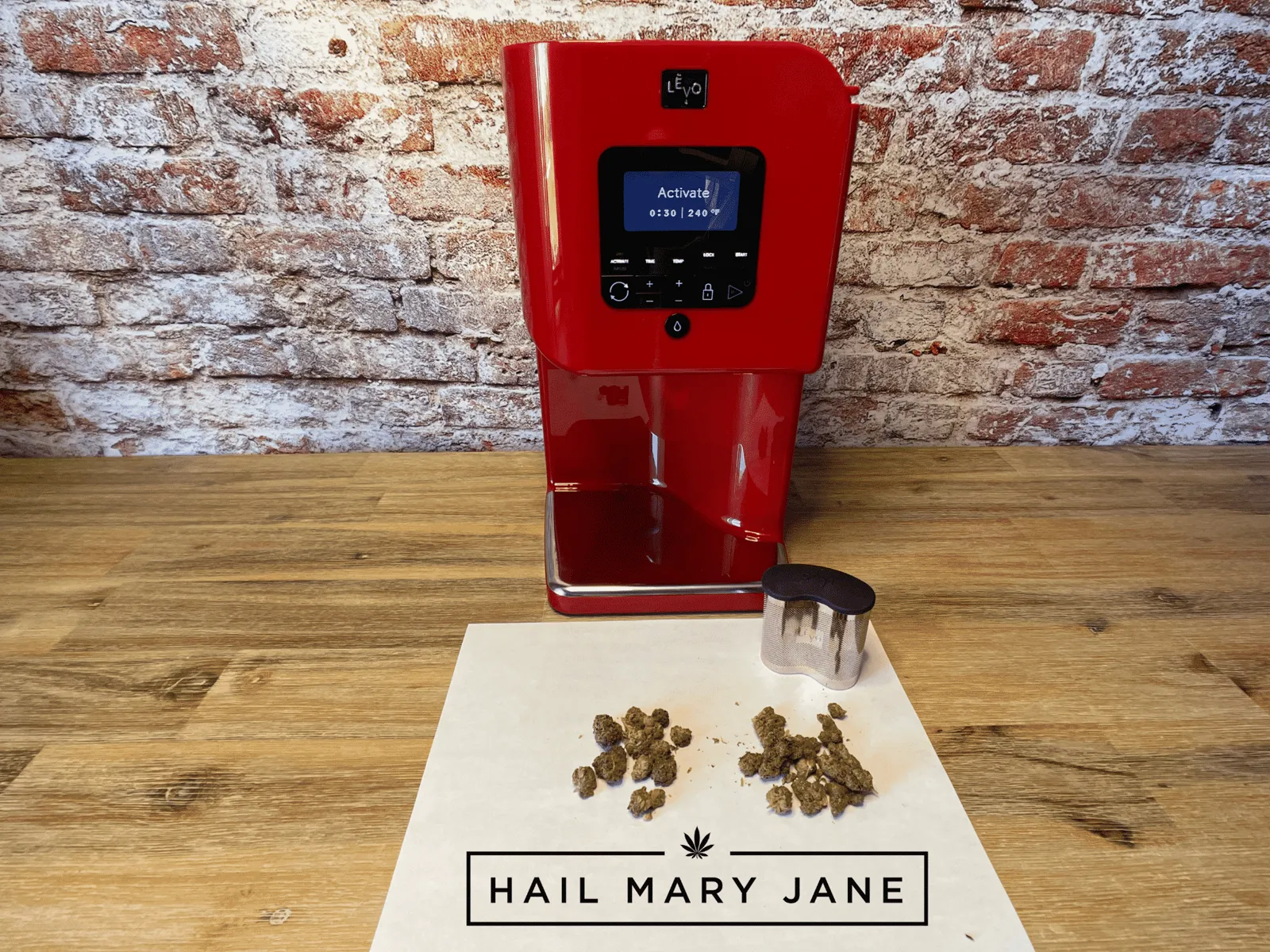
What the machine does
Two jobs in one vessel. It holds ground cannabis at a controlled temperature long enough to decarboxylate it, and it then holds it in warm fat, stirring, long enough for the cannabinoids to move into the fat. A pan on a hob does both as well, badly, and a machine exists because the first job is the one people get wrong.
Decarboxylation, in one step
Raw cannabis carries its cannabinoids mostly as acids: tetrahydrocannabinolic acid rather than THC. Heat drives off a carbon dioxide molecule and converts the acid to the neutral form. Nothing else happens, and nothing else needs to. Eat the plant without doing it and almost nothing converts.
What the kinetics study found
This is where the category stops guessing and starts having numbers. Wang and colleagues ran Cannabis sativa extracts in a vacuum oven at 80, 95, 110, 130 and 145 °C for periods up to sixty minutes, and measured both the acids and the neutral forms throughout.
What the numbers showed
The conversion follows first-order kinetics, meaning the rate depends on how much acid is left rather than on anything else. THCA-A decarboxylated at roughly twice the rate of cannabidiolic acid and cannabigerolic acid at the same temperature. And THCA-A went cleanly: no side reactions and no by-products, where CBDA and CBGA both showed losses the authors could not account for.
Why temperature is the variable
First-order kinetics with a strong temperature dependence is the whole design problem in one sentence. Twenty degrees is not a small adjustment; it changes the rate constant, which changes how long the hold has to be. A machine that holds a stated temperature is doing the thing that matters. A machine with a button marked butter is asking you to trust it.
What the study did not settle
It did not publish a single best temperature and time, and any page that quotes one with a decimal point is quoting nobody. What the work establishes is the shape: rates rise sharply with temperature, the acids differ from each other, and THCA-A behaves predictably. Where the evidence stops is worth knowing, because it is exactly where the recipes get confident.
Infusion is the second step
Once converted, the cannabinoids have to leave the plant material and enter something you can cook with. That is a solubility problem rather than a chemical one: warm fat, time, and agitation. It is far more forgiving than the first step, which is why machines that get the first step right rarely fail at the second.
Fat, and why it has to be fat
Cannabinoids are lipophilic. They dissolve readily in butter, in oil and in anything with a substantial fat fraction, and they do not dissolve meaningfully in water. Everything about the recipe follows from that: butterfat content is the ceiling on how much can go in, and a low-fat substitute is a low-capacity one.
Why a machine beats a pan
Not skill, but instrumentation. A pan gives you a hob dial, a guess and a thermometer you have to hold. A machine gives you a closed vessel at a set point with the heat applied around it rather than under one spot. The difference shows up as consistency between batches, which is the thing home infusion is worst at.
Stirring, and why it matters
Plant material floats, mats and insulates itself. Without agitation the fat at the wall runs hotter than the fat in the middle and the material at the top barely infuses. Every machine worth buying stirs, and the ones that stir intermittently rather than continuously are making a noise trade, not a chemistry one.
The vessel and its coating
Look at what the fat touches. Bare stainless is inert and easy to judge. A non-stick coating is almost always a perfluorocarbon resin, and in the US those are regulated as food-contact materials under 21 CFR 177.1550, which sets hard extraction limits: total extractives no greater than 3.1 milligrams per square decimetre, and fluoride extractives no greater than 0.46.
What that rule is worth
It is worth exactly as much as a manufacturer willing to name it. A company that can point at the regulation its coating complies with is a different proposition from one that writes non-stick on the box and says nothing else. The same applies to the silicone seals and gaskets, which fall under 21 CFR 177.2600 and are demonstrated compliant by extraction testing in distilled water and in n-hexane.
Capacity and the small batch
Most machines have a minimum as well as a maximum, because the stirrer and the temperature probe both need to be submerged. A machine sized for a pound of butter is a poor tool for a stick of it, and the small batch is what most households actually make. Check the minimum before the maximum.
Straining, and what it costs
Whatever comes out has to be separated from the plant material, and every method loses some fat to the material. A fine mesh is quick and leaves sediment; cloth is slower, clearer, and holds on to more of what you made. Machines that ship with a press rather than a bag are acknowledging the problem.
Potency cannot be measured at home
This is the honest limit of the whole exercise. You know roughly what went in, you do not know what fraction converted, you do not know what fraction transferred to the fat, and you do not know what the straining kept. Online calculators multiply three assumptions together and present the product as a figure.
What follows from that
Handle the output of any home infusion as an unquantified one, keep it labelled and separate from ordinary food, and start far below whatever a calculator told you. That is a handling instruction about an unknown quantity, not advice about how much anyone should take.
Cleaning, and the resin problem
Warm fat and plant resin together make a film that ordinary washing-up does not shift, and it collects around the stirrer shaft and the lid seal first. Whatever the manual says about the dishwasher, the seal and the shaft are hand jobs. A machine whose vessel does not come apart is a machine you will clean badly.
How to choose, in one paragraph
Buy the one that shows you a temperature in degrees and holds it, with a vessel that comes apart for cleaning, a stated minimum batch you will actually hit, and a manufacturer who will name the food-contact standard its coating and seals meet. Ignore programme counts and preset names. Every machine in this category does the same two things, and only the first one is difficult.
We do not carry prices or stock here, and we do not run a shop. For what is on a shelf near you and what it costs, that is BudFinders.