What you are trying to achieve
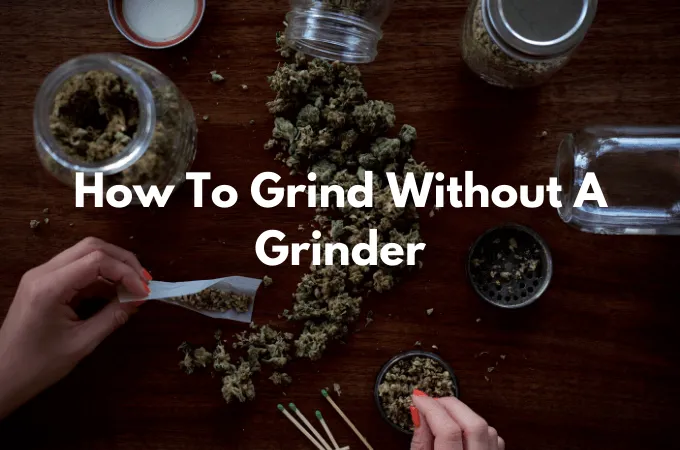
Three things, in order: pieces of roughly equal size, no material lost to sticky fingers or a rough surface, and nothing added that you would rather not inhale. Most improvised methods manage one of the three and quietly fail the other two.
Scissors and a shot glass
Drop the flower into a narrow glass and cut downward with small scissors, turning the glass as you go. The walls keep everything under the blades, so material cannot escape, and the cut is a shear rather than a crush — the same action a grinder tooth performs. Nail scissors are better than kitchen ones because the blades are short and stiff.
Why the glass matters
Cutting on an open surface loses material to static and to the blades, and it never produces an even result, because pieces scatter the moment they are cut. A shot glass, a small jar or an espresso cup all work; the requirement is straight sides and a narrow base.
A knife and a chopping board
Faster than scissors for larger amounts and noticeably worse for small ones. A sharp knife and a rocking cut gives an even result; a blunt one crushes and smears resin onto the board, which is material you are not getting back. Corral it into a pile as you go.
Board hygiene, which is not a joke
You are using a food preparation surface. The USDA’s guidance on cutting boards is the relevant one: wash boards with hot soapy water after use, sanitise plastic boards with about one tablespoon of unscented liquid chlorine bleach per gallon of water, rinse and air dry, and throw out any board that has developed grooves too deep to clean. A board that has had raw meat on it needs that treatment before flower goes anywhere near it.
Mortar and pestle
The oldest method here and the one most people get wrong, because the motion is a press and a roll rather than a pound. Pounding compacts flower into a mat. Pressing and rotating breaks it apart. It leaves a good deal of resin in the bowl, so it suits a porous stone bowl least and a glazed ceramic one best.
Let it dry out first
Every one of these methods works better on flower that has had fifteen minutes on a plate, and better again on flower straight out of the freezer. Cold resin is brittle, so it fractures and falls away instead of smearing onto whatever you are using.
A coin in a container
The pill-bottle trick: flower and a coin in a sealed container, shaken hard. It does break material up. It also puts a circulated coin in direct contact with everything you are about to inhale, and coins are among the dirtier objects in a pocket. If you are going to do it, use something else the same shape — a clean steel washer or a glass marble does the identical job.
Why the result is uneven anyway
A shaken container grinds by impact, and impact is indiscriminate: the small pieces keep getting smaller while the large ones absorb the hits. You end up with dust and lumps rather than an even grind, which is the specific failure that makes a joint burn down one side.
A cheese grater
It works on the finest setting and it is the worst method here for resin. A grater has a very large surface area of sharp metal, and every square centimetre of it collects the sticky part of what you are grating. Rubbing it back and forth leaves a visible film behind. Use it when nothing else is available and accept the loss.
What a grater costs you
That film is the resin. Cannabis glandular trichome heads are 40 to 110 micrometres across and they detach easily, which is exactly why a grinder has a screen under the chamber to catch them. Smeared onto stainless steel, they are simply gone.
A coffee grinder
Very fast, very fine, and too fine for most purposes: a blade coffee grinder takes flower to powder in a couple of seconds, which packs into a joint badly. Pulse it in short bursts rather than holding it down, and stop earlier than feels right.
The cross-contamination problem
This is the real objection. A blade coffee grinder cannot be taken apart, so resin stays in the seams and in the bearing housing, and the next coffee you make picks it up. Coffee oils go the other way. If you are going to do this, keep a second grinder for the purpose and label it; they cost less than most four-piece grinders do.
A blender is too much machine
A blender has too large a chamber for the amount involved, so flower rides the sides while the blades spin under it, and the fraction that does get cut goes straight to dust. It is the method most likely to end with material sprayed around a jug you then have to wash.
Just using your hands
Perfectly workable and the fastest option for a single bowl. It costs you the most resin of anything here, because the sticky part ends up on your fingertips, and it produces the least even result. Break rather than roll, and work over whatever you are filling so nothing is lost on the way.
The freezer, again
If you take one thing from this page: chill the flower for five minutes before you start, whatever method you are using. It is the single change that makes hands, scissors, a board and a mortar all work noticeably better, and it costs nothing. Five minutes is enough and an hour is not better, because flower left long enough to take on moisture from the freezer comes out damp, and damp flower smears against every one of these tools rather than breaking away from them.
The methods, side by side
Ranked on the three things that actually matter, from a kitchen drawer and nothing else.
| Method | Evenness | Resin kept | Hygiene |
|---|---|---|---|
| Scissors in a glass | Good | High | Good, if the glass is clean |
| Knife and board | Good on quantity | Medium | Depends entirely on the board |
| Mortar and pestle | Medium | Medium, lower on stone | Good |
| Coffee grinder | Too fine | High | Poor unless kept separate |
| Hands | Poor | Lowest | Good |
| Cheese grater | Medium | Lowest | Good |
| Coin in a container | Poor | High | Poor with a circulated coin |
| Blender | Poor | Medium | Good |
What none of these give you
A screen. Every method here leaves the resin on the flower or on the tool, and none of them separate it, which is the one thing a four-piece grinder does that a kitchen cannot. That is worth knowing before you decide the improvised version is good enough permanently.
What to buy so you can stop
Almost any machined, anodised three or four-piece grinder ends this problem for years. The specifications worth checking before you buy — tooth count, screen rating, anodising grade — are in our guide to grinders, and once one arrives, how to use a weed grinder covers getting an even grind out of it.

Questions people ask
What is the best way to grind weed without a grinder?
Scissors in a shot glass. The straight walls hold everything under the blades so nothing is lost, and scissors shear the material the way a grinder tooth does rather than crushing it. Small, stiff blades work better than kitchen scissors, and turning the glass as you cut keeps the result even.
Can I use a coffee grinder to grind weed?
Yes, in short pulses rather than holding it down, because it will go to powder in seconds and powder packs badly in a joint. The catch is cleaning: a blade grinder does not come apart, so resin stays in the seams and transfers to the next coffee. Keep a separate one for the job if you plan to do it more than once.
Is the coin and pill bottle method safe?
It works, but a circulated coin is one of the dirtier things in a pocket and it touches everything you are about to inhale. A clean steel washer or a glass marble does exactly the same job. The result is uneven either way, because shaking grinds by impact and the small pieces keep getting smaller while the large ones do not.
Does grinding by hand waste weed?
It costs you the resin rather than the flower. The glandular heads that carry most of the potency are 40 to 110 micrometres across and detach very easily, so what sticks to your fingertips or smears onto a grater is the part a grinder would have caught on its screen. Chilling the flower first makes the resin brittle and reduces the loss.
Sources
- Cutting Boards. US Department of Agriculture, Food Safety and Inspection Service, Food Safety Basics. .gov accessed Sep 18, 2026
- Punja ZK, Sutton DB, Kim T. Glandular trichome development, morphology, and maturation are influenced by plant age and genotype in high THC-containing cannabis (Cannabis sativa L.) inflorescences. J Cannabis Res. 2023;5:12. accessed Sep 18, 2026
- Food Code 2022. US Public Health Service, Food and Drug Administration. Chapter 4, cleaning and sanitizing of food-contact surfaces. .gov accessed Sep 18, 2026