
What a pre-roll legally is
Worth starting with the regulation rather than the marketing, because the two do not say the same thing. California defines a pre-roll, at 4 CCR § 15000(bbb), as any combination of the following rolled in paper: flower, shake, leaf, or kief that is obtained from accumulation in containers or sifted from loose, dry cannabis flower or leaf.
Flower, shake, leaf or kief
Read that list again. Flower is one of four permitted inputs, not the required one. A product lawfully sold and lawfully labelled as a pre-roll may contain no intact flower at all. That is not a scandal and it is not fraud; it is the definition, and almost nobody buying one knows it.
Why that definition matters
Because it tells you what question to ask. The interesting thing about a pre-roll is never the strain name on the tube. It is which of those four things went into it, in what proportion, and whether the seller is willing to say. Everything else on this page follows from that.
What shake and trim are
Shake is what falls off flower in handling and settles at the bottom of the container: small fragments, plus whatever leaf came with them. Trim is the leaf cut away from the bud. Both contain cannabinoids, both are legitimate inputs, and both are worth a great deal less than the bud they came off. A pre-roll built from them is a cheaper product sold at a flower price if you do not ask.
Reading the label
Net weight will be there because it has to be, and the cannabinoid figure will be there because it has to be. What is usually absent is the composition. A producer filling with whole-flower says so on the tube, in those words, because it is the thing worth saying. Silence is the answer to the question.
Infused pre-rolls are different
A separate regulatory category, defined at § 15000(ff) as a pre-roll into which cannabis concentrate other than kief, or another ingredient, has been incorporated. The distinction carries through to testing: laboratories apply the dried-flower method to a non-infused pre-roll and a different one to an infused product, because they are not the same thing in a tube.
What kief in the roll does
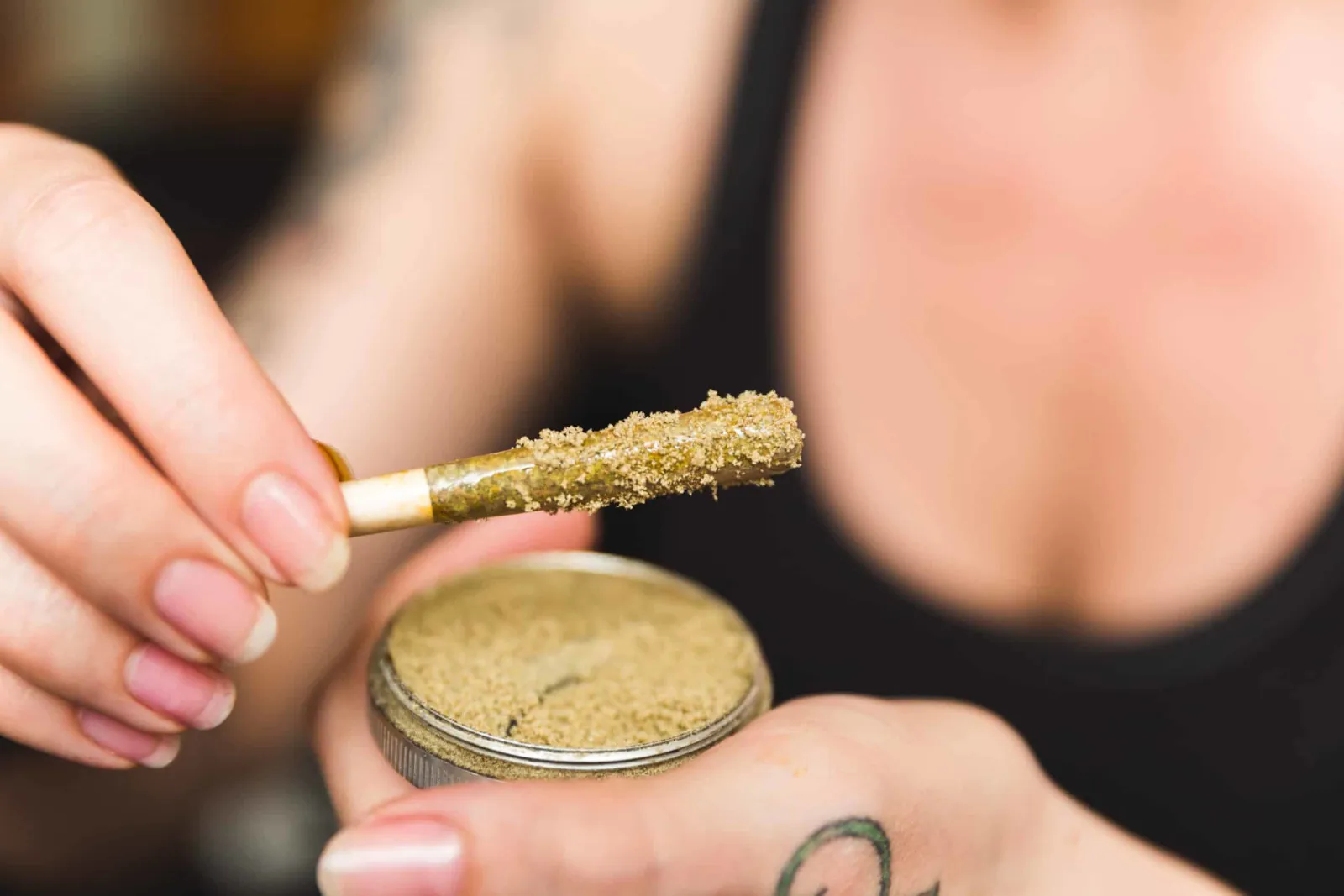
Kief is the sifted resin, and note that the regulation lists it as an ordinary pre-roll input rather than as an infusion. Rolled through the body it raises potency and it also changes how the thing burns: resin melts before it combusts, so a kief-heavy roll runs unevenly and tends to gum the end nearest your mouth. A kief coating on the outside is a different trick again, and mostly a visual one.
The grind decides the burn
More than the paper, more than the tightness of the pack. An even grind burns as a flat front down the tube. An uneven one leaves large pieces the ember has to work around, and it goes out. Machine-rolled product is usually ground consistently, which is the one thing a machine reliably does better than a person.
Why a pre-roll canoes
Running down one side is nearly always density rather than paper. Somewhere along the tube the pack is looser on one side, air takes the easier route, and the ember follows the air. A pre-roll packed by machine and then knocked about in a pocket arrives with its density redistributed, which is why the one at the bottom of a bag canoes and the one from the fresh tube does not.
The crutch, and what it does
The rolled card at the end does three real jobs: it keeps the end open so the draw does not collapse, it stops fragments coming through, and it holds the last of the roll away from your fingers. Those are genuine, and a pre-roll without one wastes the last portion.
What the crutch does not do
It is not a filter. A spiral of card removes nothing from smoke; it is a spacer with a hole through it. Cellulose acetate filters of the kind used on cigarettes do remove some particulate, and they are rare on cannabis pre-rolls. Anyone selling a card crutch as a filter is selling you a tube.
Paper, and what it adds
Thin unbleached hemp or rice paper contributes very little to the taste and burns at roughly the rate of the material inside it. Thick, heavily processed or flavoured paper contributes a great deal, and burns faster than the contents, which is the other cause of an uneven burn. If the first draw tastes of paper, it is the paper.
Weight, and what you get
Half a gram and one gram are the two common sizes, and the net weight is on the label. The useful comparison is not between two pre-rolls but between a pre-roll and the same weight of flower in a jar, where you can see what you are getting. The convenience is real; so is the premium.
Freshness and the harsh draw
A pre-roll is ground cannabis with a very large surface area exposed to air inside a tube. Ground material dries and oxidises faster than intact bud does, and a dry pre-roll burns hotter and harsher. This is the single commonest reason a pre-roll disappoints, and it has nothing to do with what went into it.
What combustion produces
Every pre-roll is burned rather than heated, and it is worth knowing what that means in measured terms rather than in argument. Combustion is not vaporization and the outputs are not comparable.
The measured comparison
Moir and colleagues ran marijuana and tobacco cigarettes on the same two machine smoking regimes and analysed both mainstream and sidestream smoke. Ammonia in mainstream marijuana smoke came out at up to twenty times the tobacco figure. Hydrogen cyanide, nitrogen oxides and aromatic amines came out at three to five times. Polycyclic aromatic hydrocarbons went the other way in mainstream smoke, and the other way again in sidestream. Those are measurements, reported as measurements. If they matter to you, the answer is a vaporizer, which heats rather than burns.
Storing them properly
In the tube, closed, out of light, and not in a warm pocket. The tube is a humidity container and it only works shut. A pack of pre-rolls in a paper sleeve is a pack that will be dry within weeks, and nothing you do afterwards brings it back.
Rolling your own instead
The argument for doing it yourself is entirely about knowing what went in. You choose the material, you control the grind, and you roll it the day you smoke it. The argument against is that consistent hand-rolling takes practice most people never get. A grinder does more for the result than any other single thing.
When a pre-roll is right
When you want one joint, now, without carrying anything. When you are somewhere that grinding and rolling is not practical. When you want to try a strain once. Those are good reasons and they are worth the premium. Wanting a week of smoking is not one of them.
How to judge one at the counter
Ask what is in it and watch whether the answer is specific. Look for the words whole flower on the tube, and read their absence as information. Check the net weight against the price rather than against another pre-roll. Feel whether the tube is sealed. And buy the freshest thing on the shelf, because ground cannabis ages faster than anything else in the case.
We do not carry prices or stock here, and we do not run a shop. For what is on a shelf near you and what it costs, that is BudFinders.