
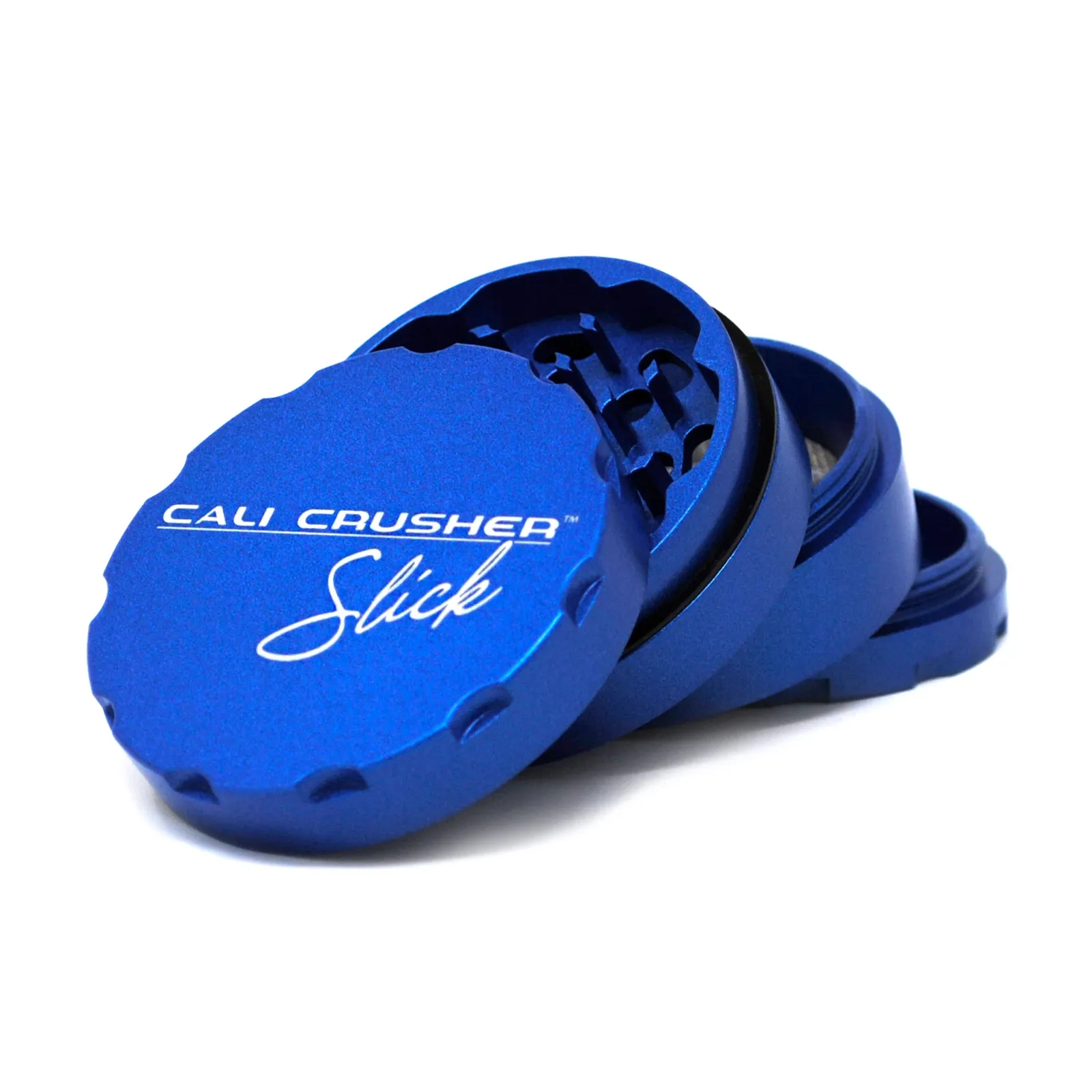
What a grinder actually does
Two jobs, and only one of them is obvious. The first is to reduce flower to pieces of roughly equal size, because a joint packed with uneven pieces burns down one side and stops at the big ones, and a bowl packed with whole nuggets chars on the outside while the middle stays green. The second is to collect the resin that otherwise ends up stuck to your fingers.
The numbers that actually matter
Grinders are sold on piece count, colour and the phrase aircraft grade. None of those three tells you much. Three other things do: the micron rating of the screen, the anodising specification of the shell, and the number and shape of the teeth. Two of them are usually printed somewhere on the listing. The third you can count in the product photograph, and almost nobody does.
Two, three, four or five pieces
A two-piece grinder is a lid and a chamber. There are teeth, and nowhere for the ground flower to go except back among the teeth, so it keeps grinding whatever you have already ground. A three-piece adds a collection chamber underneath, so material falls out of the way as soon as it is small enough. A four-piece adds a screen and a kief chamber below that. Five-piece designs split the kief chamber or stack a second, finer screen.
The only jump that changes the grind itself is two to three. Everything above that is about what happens to the resin.
What the kief screen has to catch
Kief is not dust. It is mostly the detached glandular heads of capitate-stalked trichomes, and those have a measured size rather than a rhetorical one. Punja and colleagues at Simon Fraser University photographed and measured them through eight weeks of flower development: glandular heads ranged from 40 to 110 micrometres across, averaging 75 to 90 micrometres at six weeks, sitting on stalks 300 to 500 micrometres long.
Micron ratings, in real numbers
That range is the entire design problem. The screen has to pass a 40-micrometre head while holding back leaf fragments an order of magnitude larger, and the two overlap at the coarse end.
| Screen rating | What gets through |
|---|---|
| Around 75 micron | The larger resin heads and very little else |
| Around 100 micron | Most heads, plus some fine leaf |
| Around 150 micron | Effectively everything, including material you did not want |
A coarse screen fills the bottom chamber faster, which reads as a better grinder and is the opposite. Kief that comes out green is leaf. Kief that comes out pale blonde is resin.
Teeth shape, and why it matters
Three profiles are common. Diamond teeth are cut on four faces and shear the material; they are the default on anything machined rather than cast. Pin teeth are plain cylindrical posts that tear instead of cutting, which is slower and leaves a fluffier, less uniform grind. Sharktooth or angled blade profiles are raked so they pull material inward rather than pushing it against the wall, which is what stops the ring of uncut flower that collects at the edge of a cheap grinder.
How many teeth is enough
Count them in the photograph. A 55 mm chamber carrying fewer than about thirty teeth leaves gaps wide enough for a dense nugget to ride over, and that is the grinder that needs six full turns and still leaves a lump in the middle. Machined grinders at that diameter usually carry forty to fifty. Cast ones carry fewer, and the ones they carry are blunter.
Aluminium and the anodising spec
Aircraft grade describes the alloy, almost always 6061, and the alloy is the cheap part. The surface is what matters. Anodising grows a hard oxide layer on the metal, and the US military specification every process sheet still descends from, MIL-A-8625F, separates the grades sharply: Type II sulphuric anodising runs 0.0002 to 0.0006 inches thick, roughly 5 to 15 micrometres. Type III hardcoat runs 0.001 to 0.002 inches, several times deeper and much harder.
Why bare aluminium is a problem
Unanodised aluminium is soft enough that steel teeth working against it will shed it. That is what the grey dust in the bottom of a very cheap grinder is, and it is the single best reason to skip the unbranded ones. An anodised shell in any colour, black included, has had that layer grown on it. A raw silver shell frequently has not.
Threads gall, magnets do not
Aluminium threads seize against aluminium threads — galling, in the trade — and resin in the thread makes it worse. A grinder that has become hard to turn is nearly always a threaded one whose threads have picked up. A magnetic lid on the grinding chamber sidesteps the problem completely, which is why almost every good grinder uses a magnet on top and keeps threads only for the chambers that have to seal.
Non-stick coatings and the rules
Some grinders are sold with a slick internal coating, and it is nearly always a perfluorocarbon resin. In the US those are regulated as food-contact materials under 21 CFR 177.1550, which sets hard extraction limits: total extractives no greater than 3.1 milligrams per square decimetre, and fluoride extractives no greater than 0.46. A manufacturer who can name that rule is a different proposition from one who just writes non-stick on the box.
Wood, acrylic and novelty grinders
Wooden grinders look good, and their teeth are usually steel pins driven into the wood, which works until the wood swells or a pin works loose. Acrylic ones are the cheapest thing on the shelf and their teeth round off within weeks. Neither takes a screen worth the name. They are gifts rather than tools, and there is nothing wrong with that as long as you know which you are buying.
Grind size changes how it burns
Finer is not better; it is different. A fine grind packs densely, restricts airflow and burns hot, which suits a vaporizer oven and chokes a joint. A coarse grind draws easily and burns unevenly. Most of the complaints people have about a grinder are actually complaints about how long they turned it.
When an electric one earns its place
A manual grinder asks for a pinch grip and a twist of the forearm, held against resistance. That is a small ask until it is not. If it is, or if you are filling a lot of cones at once, an electric one does the same work from a button. We have gone through the category in detail on electric weed grinders, including the one thing nearly all of them give up.
Keeping one working
Resin is the reason grinders get returned. It builds on the teeth, thickens in the threads and eventually blinds the screen so nothing falls through. None of it is difficult to reverse, but alcohol and heat both have limits depending on what the grinder is made of, and freezing it first is the step most people skip.
How to choose, in one paragraph
Buy machined rather than cast, anodised rather than raw, four-piece if you want the kief and three-piece if you do not care, with a magnetic top lid and a screen whose micron rating the seller is willing to state. Forty-odd diamond teeth in a 55 mm body will outlast several of the cheap ones. If you want to know how to get the most out of it once it arrives, start with how to use a weed grinder; if you are standing in a kitchen without one right now, grinding without a grinder covers what actually works.
We do not carry prices or stock here, and we do not run a shop. For what is on a shelf near you and what it costs, that is BudFinders.