
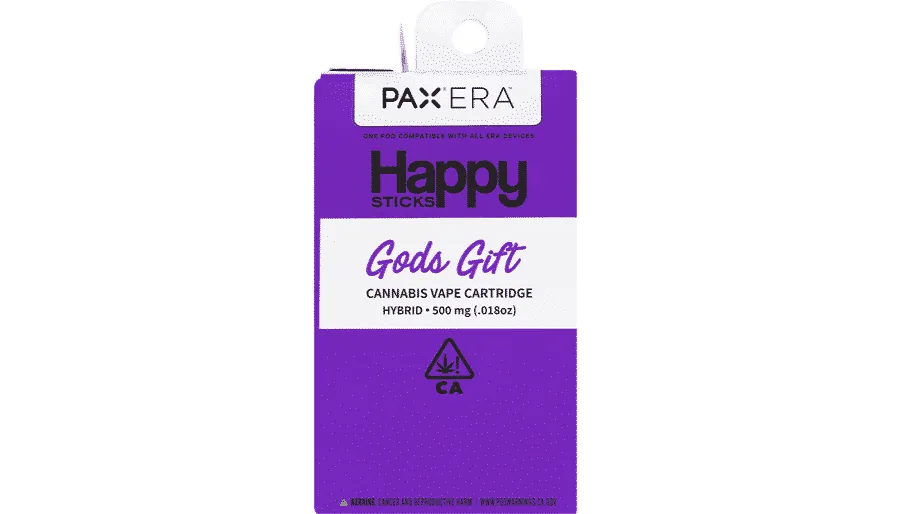
What a Pax Era pod is
A small sealed plastic cartridge holding cannabis oil, with the coil and the mouthpiece built into it, that clips magnetically into a battery about the size of a stick of gum. There is nothing to screw in, nothing to clean and nothing to set. When it is empty it goes in the bin with the coil still inside it.
Pax does not fill the pods
Worth being clear about, because the branding obscures it. The oil in a Pax pod is made by a licensed cannabis producer, and which producers those are depends entirely on the state you are in. Pax makes the hardware and sets the terms. What you are actually choosing when you pick a pod is an extractor, not Pax.
PodID, and the chip in the pod
The feature that separates this from every other closed system. Newer pods carry a small NFC chip, and holding a phone to the pod pulls up an entry for that batch. It is not a link to a product page; it is tied to the pod in your hand.
What the chip actually carries
Pax describes PodID as carrying the oil content, the strain and its potency, the flavour profile, the producer, and the state-regulated test results for the batch. In other words, the certificate of analysis that normally lives in a filing cabinet, attached to the object it describes.
What PodID can verify
Two useful things. That the pod is a pod Pax knows about, which is the counterfeit question. And what was in that specific batch when it was tested, which is the contents question. Neither is available to you at all on an unbranded cartridge bought over a counter.
What PodID cannot verify
What has happened to the oil since. A certificate describes a sample taken at a point in time, under a method the state prescribes, and it says nothing about storage, heat or age. It also cannot tell you whether the laboratory that produced it was a good one, which is a real variable in this industry and not one a consumer can audit.
The standard Pax says it holds
Pax publishes its own requirement, and it is stricter than the regulations: non-detect or below the limit of quantitation for heavy metals, microbial contamination, mycotoxins, pesticides and residual solvents, with certificates accepted only from laboratories Pax has vetted. That is a manufacturer claim rather than an independent finding, and it is a claim specific enough to be held to.
Four temperatures, not a dial
The Era offers four temperature modes rather than a continuous setting, running from 520 to 790 °F. That is a wide span, and the top of it is a great deal hotter than anything a flower vaporizer offers, because oil and plant material are not the same problem.
Why a preset beats a dial here
Because the coil, the oil and the power are designed together. On an open cartridge you pick a voltage and the coil temperature is whatever that produces, which varies with the coil. Infrared thermography of cartridge hardware found a temperature-controlled pod holding 420 °C to within about ten degrees, while voltage-controlled batteries averaged 443 to 543 °C and swung by fifty to a hundred degrees between puffs.
Why the pods are sealed
The seal is doing the same work as the chip. A pod filled, capped and tested as one unit has a known history; a cartridge that can be opened does not. Everything good about this system follows from the pod being a closed object, and everything annoying about it follows from the same thing.
Half a gram, and what it lasts
Pods hold about half a gram, which in ordinary use is a week or two rather than a month, and the figure worth knowing is draws rather than millilitres, because draws map to how often you reach for it. The device heats only while you inhale, so a short draw costs proportionally less. There is no window to check the level through, which is the one thing a glass 510 cartridge does better.
Refilling one, and why not
People do it and it is a bad idea. The coil in a Pax pod was matched to the oil that went in at the factory, and an unknown oil on that coil is precisely the failure the closed design exists to remove. It also voids any recourse you had and makes the chip a liar: the certificate now describes something that is no longer in the pod.
The counterfeit problem
Fake Pax-branded pods were widespread during the 2019 vaping-injury outbreak and the hardware is easy enough to copy that they never entirely went away. A convincing counterfeit is indistinguishable from a real pod by eye. It is not indistinguishable to a phone, which is the whole argument for buying a system that has a chip in it.
What the outbreak established
Vitamin E acetate, used as a thickening agent in illicit cartridges, was identified in the bronchoalveolar-lavage fluid of patients in the outbreak, which moved the investigation from a list of suspects to one. Of the 2019 patients who named a source, 78 per cent had used informal ones only. The lesson was never about the hardware.
Where a chip actually helps
It closes the gap the outbreak exposed. The problem was never that people chose the wrong temperature; it was that they could not tell what was in the cartridge or where it came from. A pod that answers both questions to a phone is a genuine answer to a genuine failure, rather than a feature looking for a use.
Closed pods against 510 carts
The trade is the same one the G Pen Gio makes and it is worth reading alongside this. A closed system takes the coil temperature and the supply chain out of your hands, which is good, and it commits you to whatever the programme carries where you live, which is not.
The state-by-state problem
This is the practical catch and it is bigger than it sounds. The producers filling pods are licensed per state, so the menu in one legal state has nothing to do with the menu in another, and a battery is an ornament wherever no licensed producer is filling. Check what is actually stocked near you before buying into the system.
Charging, and the battery itself
The battery is the least interesting part of the system and it is meant to be. It charges on a small dock, it has no screen, and the only thing you set on the device is which of the four modes it is in. Everything else lives in the app or on the pod. That is the design working as intended, and it is also why losing the dock is more annoying than it ought to be.
What happened to the brand list
This page used to be a list of sixteen California oil brands with prices beside them. Most of those companies no longer exist, the prices were from another era, and live prices and stock are BudFinders job rather than ours. The list is gone and what replaced it is how to judge a pod, which does not go out of date every quarter.
How to judge a pod
Scan it before you buy it if the shop will let you, and read what the chip says rather than what the box says. Look at who the producer is and whether the certificate is recent. Prefer a pod whose strain data and test results both load over one that only half answers. And read a pod sold outside a licensed shop as an unknown, whatever is printed on it.

Questions people ask
What is PodID on a Pax Era pod?
A chip in the pod that a phone can read. PAX describes it as carrying the oil content, the strain and its potency, the flavour profile, the producer and the state-regulated test results for that batch. Two things follow: you can confirm the pod is one PAX knows about, which is the counterfeit question, and you can read what was in it when it was tested.
Can you refill Pax Era pods?
Physically yes, sensibly no. The coil was matched at the factory to the oil that went in, so putting an unknown oil on it reintroduces exactly the variable a closed system exists to remove. It also makes the chip wrong: the certificate now describes something that is no longer in the pod. And it ends any recourse you had if something goes wrong.
What temperature does the Pax Era run at?
Four preset modes rather than a continuous dial, running from 520 to 790 °F. Presets make more sense here than a dial because the coil, the oil and the power were designed together. Thermography of cartridge hardware found a temperature-controlled pod holding its set point to within about ten degrees, where voltage-controlled batteries swung by fifty to a hundred between puffs.
How do you spot a fake Pax pod?
By reading it rather than looking at it. Counterfeit PAX-branded pods were widespread during the 2019 vaping-injury outbreak and a good one is indistinguishable by eye. A PAXSmart pod answers to a phone and a copy generally does not, which is the practical test. Buying only from licensed shops removes most of the problem before it starts.
Sources
- PodID. PAX Labs: the data a PAXSmart pod carries, including oil content, strain, potency, producer and state-regulated test results. accessed Sep 18, 2026
- Our Commitment to Quality and Transparency. PAX Labs: the non-detect and below-limit-of-quantitation testing requirement PAX states it holds pod fillers to. accessed Sep 18, 2026
- Complete Guide to the PAX ERA System. PAX Labs: four temperature modes, 520 to 790 degrees Fahrenheit. accessed Sep 18, 2026
- Oar MA, Savage CH, Rufer ES, Rucker RP, Guzman JA. Thermography of cannabis extract vaporization cartridge heating coils in temperature- and voltage-controlled systems during a simulated human puff. PLoS One. 2022;17(1):e0262265. accessed Sep 18, 2026
- Blount BC, et al. Vitamin E Acetate in Bronchoalveolar-Lavage Fluid Associated with EVALI. N Engl J Med. 2020;382(8):697-705. accessed Sep 18, 2026
- Krishnasamy VP, et al. Update: Characteristics of a Nationwide Outbreak of E-cigarette, or Vaping, Product Use-Associated Lung Injury - United States, August 2019-January 2020. MMWR Morb Mortal Wkly Rep. 2020;69(3):90-94. .gov accessed Sep 18, 2026