What the old list was
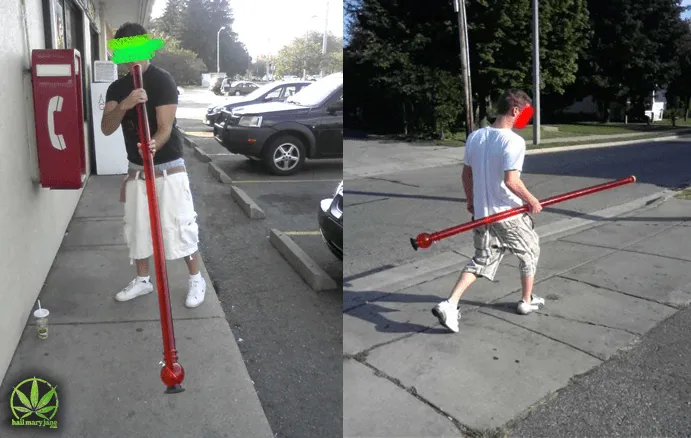
Ten videos, including a six-foot bong, an oxygen-mask bong and a gravity bong built in a swimming pool. Two of those interfere with breathing and none of them is a method — they are stunts. What follows is the set of things people actually use.
Burning: the joint
The default, and the one everything else is measured against. A tube of ground material at even density, burned from one end. Cheap, portable, needs nothing, and the least controllable: the ember temperature is whatever it is.
Burning: the pipe
The same process with less material committed at once, which is its whole advantage. A bowl can be a single draw. The trade is that the smoke travels a short distance and arrives hot, and that resin builds in a small airway fast.
Burning: water pipes
A bong cools and filters the smoke through water, which makes a large draw tolerable that otherwise would not be. Water removes some particulate and very little else, so it changes comfort far more than it changes composition.
What burning produces
Worth having the measured version rather than the argument. Moir and colleagues ran marijuana and tobacco cigarettes on the same machine smoking regimes: ammonia in mainstream marijuana smoke came out at up to twenty times the tobacco figure, with hydrogen cyanide, nitrogen oxides and aromatic amines at three to five times.
Heating: dry herb vaporizers
The material is held below combustion, so the active compounds come off as vapour and most of the plant does not burn. This is the meaningful alternative to burning rather than a gadget version of it, and the difference shows up in what reaches you.
The number behind that
Lanz and colleagues ran four electric vaporizers at 210 °C and measured what came out: between 54.6 and 82.7 per cent of the total THC was recovered into the vapour, with decarboxylation essentially complete in all of them. Same temperature, twenty-eight percentage points apart — the device matters more than the dial.
Heating: concentrates
Dabbing and cartridges are the same idea applied to extract instead of flower, at higher temperatures. Thermography of cartridge coils found a temperature-controlled pod holding 420 °C to within about ten degrees, while voltage-controlled batteries averaged 443 to 543 and swung by fifty to a hundred between puffs.
Eating: the different one
Swallowed cannabis goes through the gut and the liver before it does anything, which makes it slower to arrive and longer to last. It also has to be decarboxylated first and carried in fat, because cannabinoids do not dissolve in water. That is a different process, not a different flavour of the same one.
Why edibles catch people out
The delay. Nothing about the format announces itself early, so the second dose taken because the first seemed inert arrives at the same time as the first. And you cannot know the strength of anything made at home, which is a handling instruction rather than a caution.
Where the temperatures sit
All of it on one axis: decarboxylation was studied between 80 and 145 °C, flower vaporizers work around 180 to 220, cartridge coils measured 420 to 543, and combustion is hotter than any of them. We have drawn that scale on the products hub.
Dabbing, and why it is separate
A concentrate dropped onto a hot surface and inhaled. It belongs in the heating category but at the far end of it, and the appeal is that a very small amount carries a lot. The equipment is the complication: getting the surface to a repeatable temperature is the whole skill, and doing it by eye is how people end up far hotter than intended.
Cartridges, the convenience end
The same idea in a sealed disposable form, and by far the most popular way to consume extract. What you give up is knowing the coil temperature, which is why the thermography figures above matter: the same nominal setting on two cartridges is not the same thing at all.
Tinctures and the middle ground
An alcohol or oil extract taken by mouth. Held under the tongue some of it is absorbed directly; swallowed, it behaves like any other edible. It is the format that gives the most control over a small amount, and the one most often mislabelled as sublingual when it is not formulated to be.
Which one to pick
If convenience is the constraint, a joint. If comfort on a large draw is, a water pipe. If what reaches you is, a dry herb vaporizer, and spend the money on the oven rather than the dial. If you want it to last, eat it and respect the delay.

Questions people ask
What is the healthiest way to consume cannabis?
We are not going to make that claim, but the measured differences are worth knowing. Burning produces combustion products: machine smoking found ammonia in mainstream marijuana smoke at up to twenty times the tobacco figure, with hydrogen cyanide and nitrogen oxides at three to five times. Vaporizing holds the material below combustion so those are not produced in the same way, and eating avoids inhalation entirely.
Does a bong filter the smoke?
It cools it and removes some particulate, which makes a large draw tolerable that otherwise would not be. It does not meaningfully change what is in the smoke. Water pipes are a comfort technology rather than a filtration one, and the improvement people notice is almost entirely temperature.
Are vaporizers actually better than smoking?
They do a different thing: the material is held below combustion, so the active compounds come off as vapour without the plant burning. Four electric vaporizers run at 210 °C recovered between 54.6 and 82.7 per cent of total THC into the vapour, with decarboxylation essentially complete. Note the spread — at an identical temperature the devices were twenty-eight points apart, so the oven matters more than the setting.
Why do edibles take so long?
Because they are swallowed. Anything eaten passes through the gut and the liver before it does anything, which makes onset slow and duration long, where inhaled cannabis acts quickly and fades. That delay is what catches people out: a second dose taken because the first seemed inert arrives at the same time as the first.
Sources
- Lanz C, Mattsson J, Soydaner U, Brenneisen R. Medicinal Cannabis: In Vitro Validation of Vaporizers for the Smoke-Free Inhalation of Cannabis. PLoS One. 2016;11(1):e0147286. accessed Sep 18, 2026
- Moir D, Rickert WS, Levasseur G, Larose Y, Maertens R, White P, Desjardins S. A comparison of mainstream and sidestream marijuana and tobacco cigarette smoke produced under two machine smoking conditions. Chem Res Toxicol. 2008;21(2):494-502. accessed Sep 18, 2026
- Oar MA, Savage CH, Rufer ES, Rucker RP, Guzman JA. Thermography of cannabis extract vaporization cartridge heating coils in temperature- and voltage-controlled systems during a simulated human puff. PLoS One. 2022;17(1):e0262265. accessed Sep 18, 2026