Why no chart can answer this
A dose is established by trials that give measured amounts and record what happens. For CBD that has been done in one setting — severe childhood epilepsy, with a prescription product, by body weight, under supervision. For sleep, aches, tension or anything else, no dose has been established, and none of it was established by inhalation.
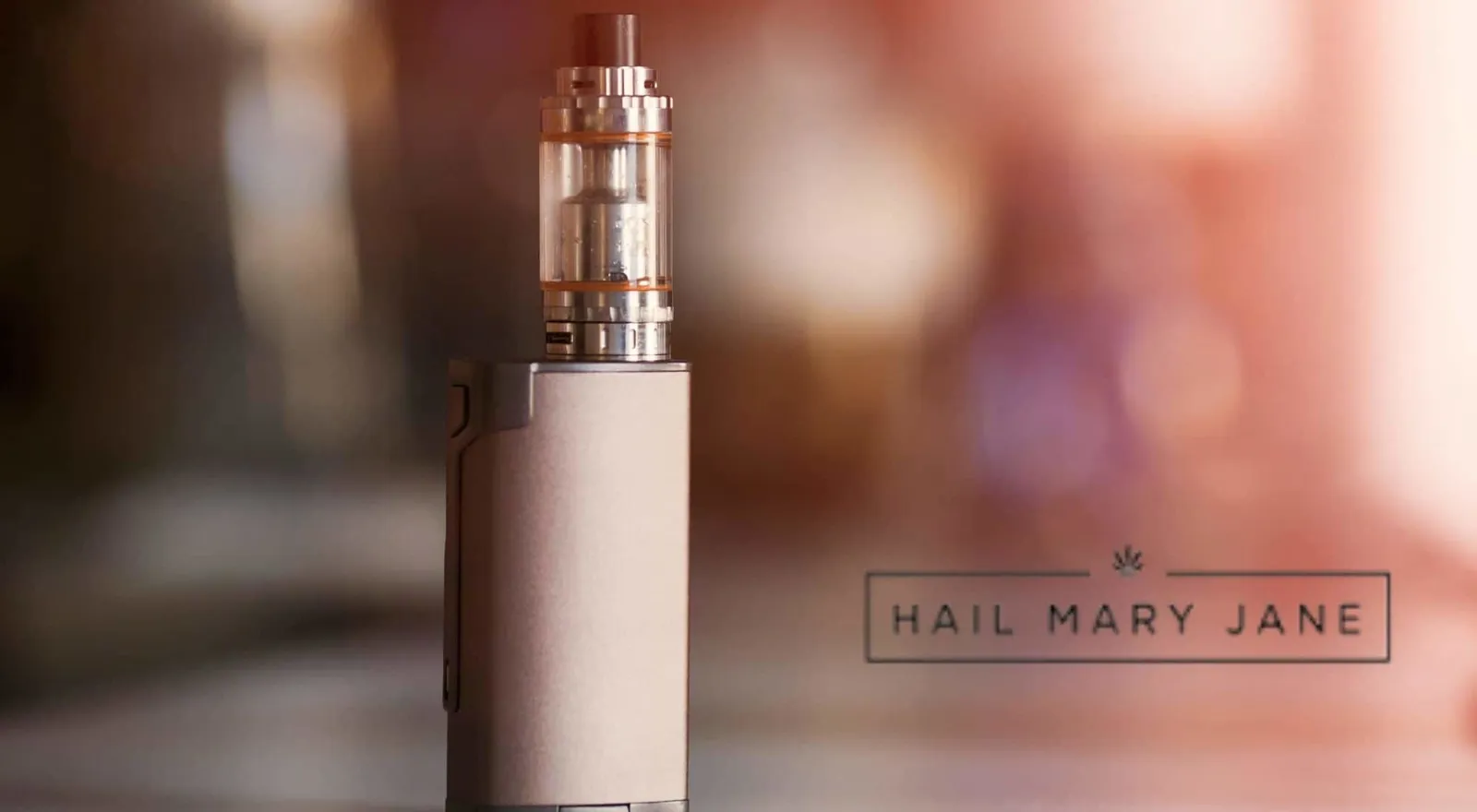
Inhalation adds a second problem on top. Even where an oral dose can be stated exactly, an inhaled one cannot: the amount that arrives depends on the device, the power setting, how long the draw is, how deep it goes and how much of the aerosol is exhaled again.
Turning milligrams into puffs
The arithmetic is rough but it is better than nothing, and almost nobody does it.
| What you know | What to do with it |
|---|---|
| A 1 ml cartridge holding 200 mg of CBD | That is 200 mg per millilitre. Most cartridges deliver somewhere around 100 to 200 puffs per millilitre, so a puff is very roughly one to two milligrams. |
| A 30 ml bottle of e-liquid holding 1000 mg | About 33 mg per millilitre. A tank holding 2 ml therefore holds about 66 mg, however many sessions that takes. |
| A disposable pen with a total and no volume | Divide the total by the manufacturer’s stated puff count if there is one. If there is not, the product cannot be dosed at all. |
The useful consequence: a whole cartridge is a much smaller number of milligrams than people assume, and a single puff is a very small one. Somebody comparing three puffs of a vape with a 25 mg gummy is comparing amounts that differ by an order of magnitude, before any difference in how much reaches the blood.
How much actually arrives
Swallowed CBD goes through the gut and the liver first, and only a fraction reaches circulation. Inhaled CBD skips both. The reviewed pharmacokinetic literature reports a higher and faster delivery by inhalation, with wide variation between studies and between people.
So the two routes are not comparable milligram for milligram in either direction: fewer inhaled milligrams may deliver more to the blood, faster, and for less time.
What inhalation is better for
Finding out whether something happens at all. An effect that arrives within minutes can be attributed to the thing you just did, in a way that an effect arriving ninety minutes after a gummy cannot — by then you have also eaten, moved, and had an hour of your day.
That makes inhalation the better tool for answering "does this do anything for me", and the worse tool for answering "how much should I take every day". Those are different questions and it is worth knowing which one you are asking.
Why the device changes the answer
- Power setting. More power vaporises more liquid per second, which means more milligrams per puff and more thermal degradation of the carrier.
- Draw length. A two-second pull and a five-second pull are not the same dose.
- Coil condition. An old coil delivers less and tastes worse; a new one delivers more from the first puff.
- The cartridge itself. Airflow and wick design vary enough that the same liquid in two devices is two different experiments.
Which is why keeping the hardware constant matters more than counting precisely. The count only means something if everything around it stays still.
A method that produces an answer
| Step | What it protects against |
|---|---|
| Pick one measure and record a week of it before starting | Without a baseline there is nothing to compare against, and memory rewrites the week. |
| One device, one liquid, one power setting | Otherwise every change is confounded by the hardware. |
| A fixed number of puffs at a fixed time | Turns an impression into a number you can repeat. |
| Two weeks before changing anything | Absorbs the ordinary day-to-day variation in whatever you are watching. |
| Change one variable at a time afterwards | Keeps the answer attributable. |
More is not reliably stronger
The instinct to take more of something that did nothing is a poor fit for this compound. In the one trial that compared CBD doses side by side for anxiety, the middle dose lowered anxiety and the highest did not. That was one outcome in one setting, by mouth rather than by inhalation, and it is still the only direct dose comparison in the literature.
What the label problem does to it
Every number above assumes the cartridge holds what it says. A 2017 analysis in JAMA found around seven in ten CBD extracts bought online were inaccurately labelled, and forensic analysis of CBD e-liquids has reported undeclared compounds including a synthetic cannabinoid.
Which makes a published batch certificate matching the code on your cartridge the difference between measuring something and estimating it. Without one, the arithmetic at the top of this page is being done on a number somebody wrote on a box.
What a certificate should actually say
"Lab tested" on a box means nothing on its own. A certificate that is worth the paper names the laboratory, carries a date and a batch code that matches your bottle, and reports more than the cannabinoid content.
- Cannabinoids, including THC. The easy half, and the only half most brands show.
- Residual solvents, left over from extraction.
- Heavy metals, which can come from hardware as well as from the plant.
- Pesticides, on a crop that is grown agriculturally.
- What was looked for and not found, which is the section that would have caught the undeclared synthetic cannabinoids described above.
A brand that publishes all five per batch is doing something the shelf does not require of it, and on a product you inhale that is most of what separates one bottle from another.
Whether tolerance applies here
People who vape nicotine or cannabis are used to needing more over time, and reasonably ask whether CBD works the same way. The honest answer is that it has not been studied in the way that question deserves.
What is known points away from it. Tolerance to THC is a well-described adaptation at the CB1 receptor, the receptor CBD does not activate in that way. There is no equivalent body of evidence describing CBD tolerance, and the long-running epilepsy trials, where people took large doses daily for months, are the closest thing to a test of it.
The practical consequence is the same as everywhere else on this page: if a dose stops seeming to do anything, raising it is a guess. Given that the one trial comparing CBD doses directly found the middle dose working and the highest not, it is a guess with a reason to be wrong.
When to stop rather than increase
The reported effects of CBD at high doses are sleepiness, loose stools and reduced appetite, and they are the sensible ceiling for an experiment. Anything sharper than that — a racing heart, disorientation, a head change that feels like intoxication — is a reason to stop and look hard at the product, because CBD is not intoxicating and something in the cartridge may not be CBD.

Questions people ask
How many milligrams is one puff?
Very roughly one to two milligrams from a typical cartridge, working from a millilitre holding a couple of hundred milligrams and delivering somewhere around a hundred to two hundred puffs. It is an estimate, and the device changes it.
Is vaping stronger than swallowing the same amount?
More of an inhaled dose reaches the blood and it arrives within minutes, where a swallowed dose is largely processed by the liver first and takes thirty minutes to two hours. The two routes are not comparable milligram for milligram.
Should I turn the power up if I feel nothing?
Higher power vaporises more liquid per puff and produces more thermal degradation of the carrier. Given that the one direct dose comparison in the literature found the middle dose working and the highest not, working upwards is not a reliable strategy with this compound.
How long before I know whether it does anything?
Inhaled effects arrive in minutes, so a single session answers "did I notice anything". Whether it helps with something gradual needs a fortnight of the same device, liquid and routine, with a measure recorded at the time.
Sources
- Millar SA, et al. A Systematic Review on the Pharmacokinetics of Cannabidiol in Humans. Front Pharmacol. 2018;9:1365. accessed Sep 18, 2026
- Linares IM, et al. Cannabidiol presents an inverted U-shaped dose-response curve in a simulated public speaking test. Braz J Psychiatry. 2019;41(1):9-14. accessed Sep 18, 2026
- Poklis JL, Mulder HA, Peace MR. The unexpected identification of the cannabimimetic, 5F-ADB, and dextromethorphan in commercially available cannabidiol e-liquids. Forensic Sci Int. 2019;294:e25-e27. accessed Sep 18, 2026
- Bonn-Miller MO, et al. Labeling Accuracy of Cannabidiol Extracts Sold Online. JAMA. 2017;318(17):1708-1709. accessed Sep 18, 2026